
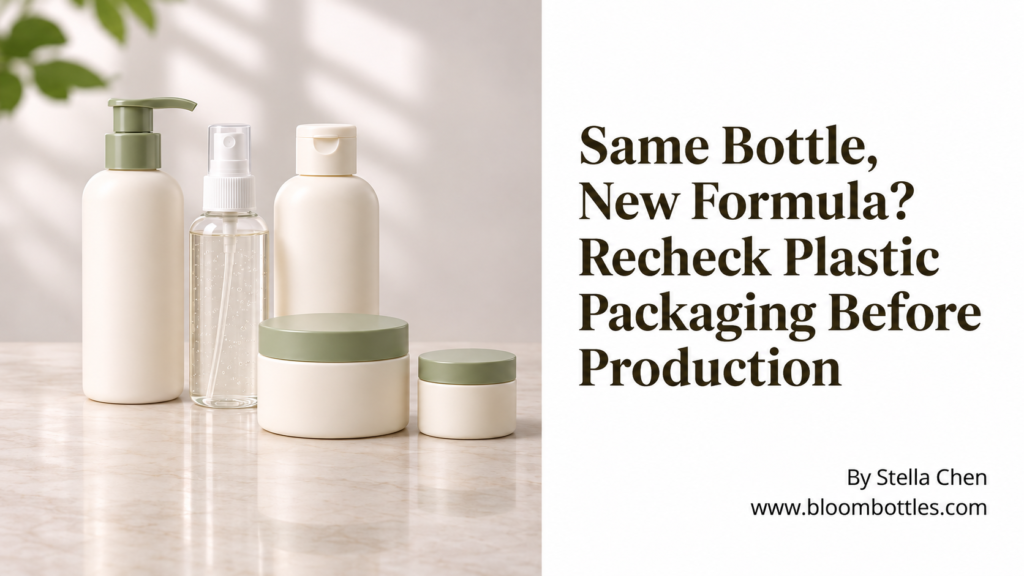
The bottle has been used successfully for several production runs. The pump works well, the decoration is approved, and the filling line already knows the packaging. Then the formula changes.
It may be a new fragrance, a different viscosity, more oil, another active ingredient or a reformulation for a new market. The packaging itself looks unchanged, but plastic packaging formula compatibility should not automatically be treated as unchanged.
A formula change can affect dispensing, sealing, material interaction, filling, labeling and long-term package performance. The safest approach is not to restart the entire packaging project, but to identify which parts of the existing system need to be checked again.
Why the Same Packaging Can Perform Differently With a New Formula
Packaging performance comes from the interaction between the formula and the complete packaging system.
A bottle that works well with one lotion does not automatically behave the same way with another. A pump that dispenses a low-viscosity formula smoothly may prime slowly with a thicker product. A liner that worked with one ingredient system may need to be reviewed when the formula changes.
This is why the question should not only be “Is the bottle the same?” It should also be “What has changed in the formula, and which packaging functions can that change affect?”
1. Start by Identifying What Changed in the Formula
Not every reformulation creates the same packaging risk.
Before repeating packaging tests, first understand what changed.
- Viscosity
- Oil content
- Alcohol content
- Fragrance system
- Surfactants
- Active ingredients
- pH
- Color
- Fill weight
- Target storage conditions
The packaging supplier does not always need the full confidential formula. In many projects, the brand or CM can identify the relevant physical and chemical changes and determine which packaging functions need another review.
2. Recheck the Bottle or Jar Material
PET, HDPE, PP and other packaging materials have different properties. A previous formula may already have demonstrated good performance with the selected material, but a meaningful reformulation can change that relationship.
Depending on the product, review possible changes in:
- Bottle stiffness
- Paneling or deformation
- Stress cracking
- Discoloration
- Odor interaction
- Product staining
- Surface appearance
- Long-term dimensional stability
This does not mean every formula change requires a new bottle material. It means the previous compatibility result should only be reused when the new formula does not introduce a meaningful new risk.
3. Recheck Pump Performance When Viscosity Changes
Viscosity is one of the most obvious reasons to retest a dispensing system.
The pump specification may remain exactly the same, but the user experience can change.
Check:
- Priming
- Number of strokes required to start dispensing
- Output per stroke
- Dispensing consistency
- Actuation force
- Product cut-off after dispensing
- Residual product around the actuator
- Ability to evacuate the product near the bottom of the bottle
A calculated pump dosage does not guarantee the same actual dispensing experience with a new formula.
For more detail, see how to avoid pump output and dip tube mistakes before filling.
4. Check Whether the Dip Tube Still Works With the New Product
A formula change does not normally change the physical bottle height, but it can change how well the product flows through the dip tube and pump system.
For thicker formulas, check whether the existing tube position and pump system still allow acceptable product evacuation.
For low-viscosity products, also review whether the dispensing system creates dripping or uncontrolled output after actuation.
The correct dip tube length should therefore remain connected to the actual bottle, pump and formula combination rather than being treated as a bottle dimension only.
5. Review Closures, Liners and Sealing Performance
Formula changes can also affect the closure system.
Depending on the pack, review:
- Cap sealing surface
- Liner compatibility
- Induction seal performance
- Closure torque
- Flip-top sealing
- Pump gasket or internal seal
- Leakage after storage
- Leakage during transportation
A bottle and closure may fit correctly from a dimensional point of view while the new formula creates a different sealing requirement.
For component-system checks, see how to avoid plastic packaging component mismatch before filling.
6. Look for Changes That May Affect Appearance
Formula compatibility is not only about leakage or mechanical failure.
A new formula can also affect the appearance of the finished package over time.
Watch for:
- Formula staining
- Bottle discoloration
- Changes in transparency
- Residue around the neck
- Oil migration
- Product buildup around the pump
- Surface marks after repeated use
These issues may not stop filling, but they can affect the consumer’s impression of the final product.
7. Recheck Labels When the Filling or Formula Environment Changes
The label material may not have changed, but the environment around it can.
For example, a reformulated product may leave more residue during filling or use a different filling temperature. Oil or product residue on the bottle surface can also affect label adhesion if the line is not controlled properly.
Review:
- Bottle cleanliness before labeling
- Label adhesive performance
- Product contact near label edges
- Filling temperature where relevant
- Label lifting after storage
- Label appearance after transportation
For physical label application issues, see how to avoid plastic packaging labeling problems before production.
8. Include the Contract Manufacturer in the Recheck
The CM sees packaging performance under real filling and assembly conditions.
A formula change may affect:
- Filling speed
- Foaming during filling
- Fill accuracy
- Nozzle setup
- Product residue around the neck
- Capping or pump assembly
- Line cleanliness
- Labeling after filling
A packaging combination that previously ran smoothly may need a small process adjustment when the product characteristics change.
9. Test Under Conditions That Match the Real Project
A short room-temperature check can identify obvious problems, but it may not answer every compatibility question.
The brand and CM should determine which storage and use conditions are relevant to the product.
Depending on the project, evaluation may consider:
- Expected storage period
- Different temperatures
- Filled-pack orientation
- Repeated dispensing
- Leakage over time
- Appearance changes
- Formula and packaging interaction
The test plan should match the actual risk rather than repeating every possible test automatically.
10. Treat the Reformulated Product as a New Approved Packaging Version
If the new formula passes the required packaging checks, record the result clearly.
The physical bottle may be unchanged, but the project now has a new approved bottle + closure + formula combination.
Record:
- Formula or project reference
- Bottle or jar specification
- Pump or closure specification
- Dip tube length
- Liner or sealing requirement
- Testing completed
- Approved sample reference
- Approval date
This prevents a future team from assuming that every formula using the same bottle automatically shares the same approval.
Once the checks are complete, the revised project should return to the normal plastic packaging approval process before production.
What Does Not Need to Be Final Before You Contact the Packaging Supplier?
You do not need to finish the reformulation before discussing packaging risk.
The following may still be under review:
- Final fragrance level
- Exact viscosity
- Final fill quantity
- Some ingredient adjustments
- Final production date
What is useful at the beginning is understanding what is changing and which packaging components may be affected.
With that information, the supplier and CM can identify which samples, components or tests may need to be prepared before the reformulated product reaches final approval.
Practical Formula Change Packaging Checklist
- Identify what changed in the formula
- Review the bottle or jar material
- Check viscosity and dispensing
- Recheck pump priming and output
- Confirm dip tube performance
- Review closure and liner compatibility
- Check leakage and sealing
- Monitor staining or appearance changes
- Review label performance where relevant
- Include the CM in filling-line checks
- Test under project-relevant conditions
- Record the newly approved packaging and formula combination
Final Thought
Using the same bottle does not always mean using the same packaging system.
When the formula changes, the smartest approach is usually not to restart packaging development from zero. It is to identify which functions may be affected and recheck those areas before the next production run.
That targeted review can protect an already successful packaging program without adding unnecessary development work.
FAQ
Do we need to retest packaging every time the formula changes?
Not necessarily to the same extent. Review what changed in the formula and whether those changes can affect material compatibility, dispensing, sealing, filling or appearance. The test scope should reflect the actual risk.
Can we keep the same pump after increasing formula viscosity?
Possibly, but the existing pump should be tested with the revised formula. Check priming, output, actuation, product cut-off and evacuation instead of relying only on the pump’s nominal dosage.
Does the packaging supplier need the complete formula?
Not always. The brand or CM can often provide the relevant formula characteristics and changes without disclosing unnecessary confidential formulation details. The information required depends on the compatibility question being evaluated.
If the bottle is unchanged, should the reformulated product have a new approval record?
Yes, where the formula change required compatibility or functional review. Recording the approved bottle, closure and formula combination helps prevent future teams from assuming that an earlier formula approval automatically applies to every later version.