
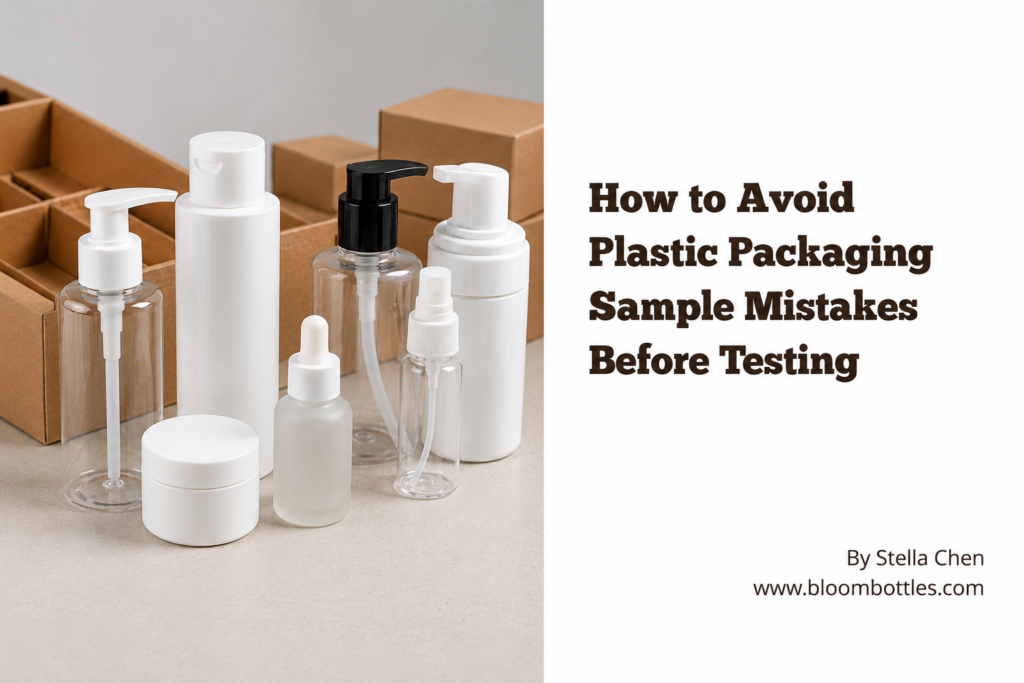
A contract manufacturer can receive a full carton of packaging samples and still be unable to run a meaningful test. The problem is often not the sample itself, but that different bottle, pump, closure or decoration versions are mixed together or not clearly identified.
Many plastic packaging sample mistakes happen before testing begins. If the CM does not know which combination represents the intended production package, the test result may not match the version that the brand eventually orders.
Clear sample preparation helps the brand, packaging supplier and contract manufacturer test the same configuration. That makes filling trials, pump checks, labeling tests and line reviews much more useful before mass production.
Why Plastic Packaging Sample Mistakes Matter
The brand, packaging supplier and contract manufacturer usually evaluate packaging from different perspectives.
The brand may focus on shape, color, decoration and overall presentation. The packaging supplier reviews component matching, dimensions, material, decoration feasibility and production. The contract manufacturer also needs to consider filling, capping, labeling, pump performance and how the package behaves on its production line.
A packaging sample can look correct and still need further functional review before production. This is why approved packaging samples before production should still be checked under the intended filling, closure and dispensing conditions. The goal is to confirm that the complete packaging system performs as expected, not only that each component looks acceptable on its own.
The purpose of CM testing is to identify these issues before packaging production is completed, not after thousands of components have already been made.
Mistake 1: Sending Only Part of the Packaging System
One common mistake is sending the bottle for testing without the final pump, sprayer, cap, liner or other functional component.
Whenever possible, the contract manufacturer should test the complete intended packaging combination:
- Bottle or jar
- Final or proposed pump, sprayer or closure
- Correct liner or gasket when required
- Correct dip tube for pumps and sprayers
- Decoration or label sample when it affects line handling
Testing a bottle with one closure and later changing to another reduces the value of the original test. The same applies when the pump, liner, dip tube or neck specification changes.
Confirming the bottle and closure system for skincare packaging before arranging CM testing can reduce unnecessary sample rounds.
Mistake 2: Treating Development Samples as Final Samples
Early development samples are useful, but they may not represent every detail of the final production package.
For example, a stock bottle in a different color may be used to confirm dimensions. A temporary pump may be used during early appearance review. A bottle without final decoration may still be suitable for an initial filling test.
There is nothing wrong with testing development samples as long as everyone understands what is temporary and what is already final.
Before sending samples, identify which characteristics match the intended production version and which details are still being developed.
Mistake 3: Sending Too Few Samples for the Planned Test
A few samples may be enough for appearance review, but they may not be enough for the contract manufacturer’s planned testing.
Different tests require different quantities. Manual filling, pump evaluation, label trials, torque checks and automated line trials do not have the same sample requirements.
Instead of assuming that five or ten samples will be enough, ask the CM what it intends to test and how many complete packaging sets it needs.
This is especially useful when samples are being shipped internationally. Confirming the quantity before shipment can avoid an additional sample shipment and another round of waiting.
Mistake 4: Mixing Different Sample Versions
Packaging projects often go through several versions before approval.
There may be two pump options, different bottle weights, different closure structures or revised decoration samples. If these versions are sent without clear identification, it becomes difficult to know which combination the CM actually tested.
Each sample version should have a simple reference that can also be used in emails, specification records and test feedback.
For example, Sample A and Sample B are already better than sending two similar components without identification. For more complicated projects, the reference can include the project name, component version and date.
The exact naming format matters less than keeping the same reference throughout the project.
Mistake 5: Sending Samples Without Basic Specifications
The contract manufacturer should not need to identify a packaging sample only by looking at it.
Useful sample information may include:
- Bottle or jar capacity
- Material such as PET, HDPE, PP or PETG
- Neck finish
- Pump, sprayer or closure specification
- Dip tube length when applicable
- Overall dimensions
- Liner or sealing requirement
- Decoration method
- Sample version
- Current approval status
For projects with several components, a clear plastic packaging specification sheet helps keep the brand, supplier and CM working from the same information.
Mistake 6: Testing the Bottle and Dispensing System Separately
A pump or sprayer should not be evaluated only as an individual component when the final application depends on the bottle and product formula.
The bottle height affects dip tube requirements. The product viscosity can affect dispensing performance. The neck and closure combination affects assembly. The filling level can also influence how the final package functions.
The CM should therefore test the intended packaging combination whenever possible instead of assuming that individually acceptable components will automatically perform well together.
Testing matched components helps reduce the risk of a plastic packaging component mismatch becoming visible only when filling starts.
Mistake 7: Changing a Component After Testing Without Reviewing the Result
Packaging changes can still happen after the first CM test. A pump may become unavailable, a closure may be changed, a liner may be added or the bottle specification may be adjusted.
The mistake is not necessarily making the change. The risk comes from assuming that the previous test automatically covers the new configuration.
When a component changes, review what the previous test actually confirmed.
A small color adjustment may have no effect on filling performance. Changing a pump, liner, neck finish, bottle dimensions or closure structure can be different. Depending on the change, part of the test may need to be repeated.
What Should the Contract Manufacturer Check?
Filling and Line Handling
The bottle or jar should be reviewed under the intended filling process rather than only under manual sample conditions.
Depending on the CM’s equipment, this may include container stability, conveyor movement, filling nozzle access, spacing and whether extra manual handling is required.
Closure and Pump Assembly
The intended closure should be checked for consistent application during production.
For screw closures, the CM may review application and opening behavior. For pumps and sprayers, testing may also include assembly, locking position, dip tube fit and dispensing performance with the actual product.
Formula and Packaging Interaction
The packaging supplier can review the physical packaging system, but the actual formula should also be evaluated by the brand and contract manufacturer under conditions appropriate for the product. The FDA’s guidance on cosmetic product testing also notes that manufacturers and distributors are responsible for ensuring the safety of cosmetic products and may need appropriate testing to support that assessment.
Viscosity, ingredients, temperature and storage conditions can influence packaging performance. This is particularly relevant for pumps, sprayers, liners and components that remain in direct contact with the formula.
Labeling and Decoration
If labeling is completed at the contract manufacturer’s facility, the bottle or jar should also be reviewed for label application.
Bottle curvature, recessed areas, available label space and surface characteristics can affect application. These issues are easier to identify with samples than after mass-produced packaging reaches the filling site.
Practical Checklist Before Sending Packaging Samples for Testing
- Confirm exactly what the contract manufacturer plans to test.
- Ask how many complete sample sets are required.
- Send the intended bottle, jar, pump, sprayer and closure combination.
- Include liners, gaskets and other functional components when required.
- Confirm that the dip tube matches the intended bottle.
- Identify each sample version clearly.
- Separate different sample versions during packing.
- Provide basic material, neck finish and dimensional information.
- State which components are final and which are still under development.
- Record CM feedback against the correct sample reference.
- Review whether later component changes affect previous test results.
- Resolve open functional issues before mass production whenever possible.
This type of preparation can also help reduce skincare packaging project delays before production. Many delays come from several small unresolved details rather than one major packaging failure.
Final Thought
Sending packaging samples to a contract manufacturer is not simply a shipping step. It is part of the packaging approval process.
A useful test depends on the CM receiving the correct component combination, the correct sample version and enough information to understand what it is evaluating.
When the brand, packaging supplier and contract manufacturer work from the same samples and specifications, test feedback becomes easier to use and packaging decisions become easier to control before mass production.
FAQ
How many plastic packaging samples should be sent for testing?
There is no standard quantity for every project. Appearance review, manual filling, pump testing, label trials and production-line tests may require different quantities. Confirm the required number with the contract manufacturer before preparing the shipment.
Can development samples be used for contract manufacturer testing?
Yes, but the CM should know which details are temporary and which already represent the intended production package. This prevents test feedback from being applied to the wrong component or version.
Should bottles and pumps be tested together?
Whenever possible, yes. Bottle dimensions, neck finish, dip tube length, product viscosity and pump configuration can all affect the performance of the complete dispensing system.
Does packaging need to be tested again if one component changes?
It depends on the change. A cosmetic adjustment may not affect previous functional testing, while changing the pump, liner, closure, neck finish or bottle dimensions may require additional review or testing.