
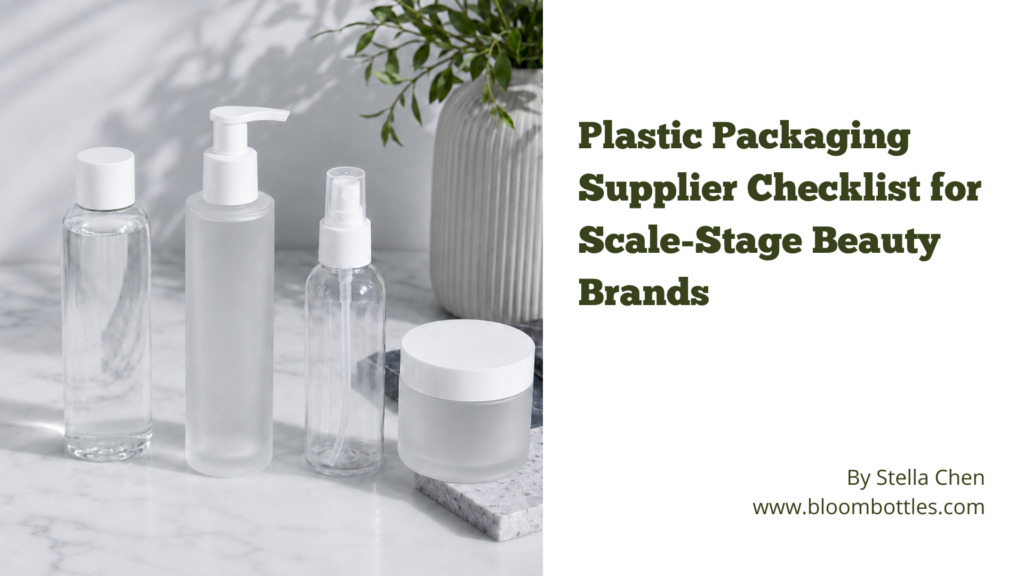
A plastic packaging supplier checklist helps beauty brands and contract manufacturers evaluate whether a supplier can support real production, not just send a nice sample or offer a low price.
A skincare brand may receive a competitive quotation and a good-looking bottle sample, but that does not always mean the supplier can support stable filling, decoration, shipping and repeat orders.
For scale-stage projects, the better question is not only whether the supplier can make the package. The better question is whether the supplier can control the packaging system through production, testing, delivery and future orders.
Scale-stage packaging projects are different from small trial orders.
At this stage, a bottle, jar, pump, cap or sprayer is not only a container. It affects filling efficiency, decoration results, leakage risk, carton packing, shipping stability, inventory planning and repeat-order consistency.
A supplier who can send a nice sample may still struggle with production control. A supplier who offers a low quotation may not have enough records, testing support or component-matching experience. A supplier who makes bottles may not fully understand how caps, pumps, liners, formulas and filling conditions work together.
For beauty and personal care brands, this can lead to hidden costs later. Many problems that look like production issues are actually caused by incomplete supplier evaluation at the beginning. This is also why packaging teams should avoid the common issues discussed in 7 common plastic packaging mistakes skincare brands make.
Production delays, decoration defects, leaking packages, unstable color, poor pump fitment or inconsistent repeat orders may cost more than the original price difference between suppliers.
That is why supplier selection should focus on project control, not only unit price.
Plastic Packaging Supplier Checklist: What Beauty Brands Should Review
Material and Product Range Capability
A good plastic packaging supplier should understand how different materials behave in real projects.
PET, HDPE, PP, PETG, PE and PCR materials are not interchangeable. Each material has different advantages, limits and production considerations. For example, PET is often used for clear bottles, HDPE is often chosen for squeezable or chemical-resistant packaging, and PP is commonly used for caps, jars and closures.
If material choice is still open, brands can first review PET vs HDPE vs PP skincare packaging before finalizing the supplier discussion.
A scale-stage supplier should be able to explain:
- Which material fits the formula and product positioning
- Whether the package needs rigidity, squeezability, transparency or chemical resistance
- Whether the material can support the required decoration
- Whether PCR content may affect color, transparency or surface finish
- Whether the selected material is suitable for production stability
The risk of weak material support is that the brand may approve a design that looks good but does not perform well during filling, shipping or repeat production.
Bottle and Closure System Knowledge
Packaging is not only about the bottle.
A bottle needs to work with the right closure, pump, sprayer, disc-top cap, screw cap, liner, dip tube or sealing structure. Even small mismatches can create leakage, poor dispensing, difficult filling or unstable torque control.
Before choosing a supplier, brands should check whether the supplier can evaluate the full bottle and closure system for skincare packaging instead of treating each component separately.
Useful questions include:
- Can the supplier recommend matching caps, pumps or sprayers?
- Can they check neck finish, thread fitment and sealing structure?
- Can they provide samples with the actual matched closure?
- Can they explain torque, liner, gasket or dip tube considerations?
- Can they support filling line feedback from the contract manufacturer?
A supplier with strong system knowledge can help reduce risk before mass production. A supplier without this ability may only confirm that each component is available, while the real issue appears later when the components are assembled and filled.
Custom Mold and Tooling Support
For scale-stage beauty brands, stock packaging is not always enough. Some projects require a new bottle shape, modified capacity, custom jar, special closure or brand-specific structure.
Custom mold support should not only mean that the supplier can quote a mold price. The supplier should understand whether the project really needs a custom mold, or whether an existing stock option can be adjusted to meet the brand’s needs. For teams still comparing both directions, stock vs custom plastic packaging can help clarify when a new mold makes sense.
Brands should check whether the supplier can support:
- 2D and 3D drawing review
- Structure adjustment before tooling
- Sample development
- Mold trial feedback
- Production feasibility review
- Tooling timeline control
- Future mold maintenance and repeat production
A practical supplier should also be honest about what can and cannot be achieved with a new mold.
For example, a design may look attractive in a rendering, but the wall thickness, shoulder shape, base structure, neck area or decoration surface may create production problems. Early supplier feedback can prevent unnecessary tooling cost and project delays.
The goal of custom molding is not only to create a different-looking package. It should create a package that can be produced consistently.
Decoration and Finishing Control
Decoration often looks like a visual decision, but it is also a production decision.
Silk screen printing, hot stamping, labeling, coating, frosting and color matching all depend on bottle shape, surface area, material, artwork, registration tolerance and packing protection.
Before selecting a supplier, brands should check whether decoration is handled as part of the packaging system.
Important points include:
- Can the supplier review artwork before production?
- Can they explain whether the surface is suitable for silk screen printing or hot stamping?
- Can they provide color references or decoration samples?
- Can they keep production records for repeat orders?
- Can they advise when a label may work better than direct printing?
- Can they protect decorated parts during packing and shipping?
A common risk is approving a bottle first and discussing decoration later. This can create problems if the bottle has a curved surface, limited front panel, unstable coating or difficult artwork position.
For scale-stage projects, decoration should be discussed before the package is fully confirmed.
PCR and Sustainability Support
Many skincare and personal care brands are now evaluating PCR plastic packaging or more sustainable packaging options. However, PCR should not be discussed only as a marketing claim.
PCR content can affect color, clarity, surface finish, odor, mechanical performance and batch consistency. A supplier should be able to explain these practical considerations clearly.
Brands should ask:
- What PCR percentages are available for the selected material?
- Can the supplier provide PCR samples for comparison?
- Will PCR affect transparency or color matching?
- Are there production limitations for the selected bottle or jar?
- Can the supplier keep approved samples and production records?
- Are claims and documentation aligned with the brand’s market requirements?
For broader packaging sustainability thinking, some teams also review resources from the Sustainable Packaging Coalition when building internal packaging guidelines.
The key point is simple. Sustainability support should include real material knowledge, not only a PCR option on a quotation sheet.
Sample, Testing and Quality Control Support
A good sample does not replace testing.
Before mass production, brands and contract manufacturers should check compatibility, filling performance, sealing, torque, drop resistance, leakage, decoration durability and transportation condition when needed.
This is especially important for products such as lotions, oils, cleansers, toners, shampoos, body care formulas and selected nutraceutical products.
Suppliers should be able to support approved packaging samples before production and help teams understand which parts need testing before the purchase order moves forward.
Brands should check whether the supplier can provide:
- Pre-production samples
- Component samples with actual matched caps or pumps
- Decoration samples
- Material references
- Color references
- Production inspection standards
- Packing details
- Quality records
- Clear approval process before mass production
A supplier who does not support sample and testing communication may leave too much risk to the brand or contract manufacturer.
Repeat-Order Consistency Support
One successful order does not automatically guarantee the next order will look the same.
For repeat orders, brands need packaging consistency across repeat orders, especially when the product is sold through retail, e-commerce, professional channels or multi-market distribution.
Brands should check how the supplier controls:
- Approved master samples
- Color records
- Decoration records
- Mold records
- Material batch information
- Component matching
- Packing method
- Quality inspection criteria
Repeat-order support is especially important for multi-SKU beauty lines. A small color shift, different pump shade, changed cap finish or decoration position change may be visible when products are displayed together.
If a supplier does not keep proper records, every repeat order becomes a new project.
Export and Communication Experience
For international beauty and personal care projects, export experience matters.
A supplier may be able to produce packaging, but still struggle with project communication, export packing, shipping documents, delivery planning or cross-time-zone coordination.
Brands and contract manufacturers should check whether the supplier understands:
- Export carton packing
- Pallet requirements if needed
- Shipping marks
- Lead time planning
- Container loading
- Commercial documents
- Communication with freight forwarders
- Production updates
- Urgent project coordination
Good communication does not mean sending many messages. It means giving clear, useful and timely information so the brand can make decisions.
For scale-stage projects, the supplier should be able to coordinate with sourcing, product development, operations, packaging engineering and contract manufacturing teams.
Common Problems When the Supplier Is Not Suitable
When a supplier is not suitable for scale-stage projects, the problems may not appear immediately.
At the beginning, the quotation may look good. The first sample may also look acceptable. But problems often appear later, when the project moves into decoration, filling, shipment or repeat orders.
Some of these problems are connected with early project information gaps. If the packaging brief is incomplete, supplier evaluation also becomes weaker. This is why brands should also understand why skincare packaging project delays happen before production starts.
Common problems include:
- The selected material does not fit the formula or product positioning
- The bottle and closure do not seal well together
- Pump or sprayer performance is unstable
- Decoration cannot be applied consistently on the chosen surface
- PCR packaging looks different from the approved sample
- Production records are incomplete
- Repeat orders show visible color or finish differences
- The supplier cannot explain quality issues clearly
- The contract manufacturer receives incomplete packaging information
- Delivery timelines become unclear after the order is placed
These problems are not always caused by bad production. Many are caused by choosing a supplier who cannot manage the full packaging system.
Practical Supplier Checklist
Before choosing a plastic packaging supplier, scale-stage beauty brands and contract manufacturers can use this checklist during sourcing, sampling and supplier evaluation.
Ask the supplier:
- What materials do you regularly produce for beauty and personal care packaging?
- Can you explain why this material is suitable for our formula and filling condition?
- Can you supply the bottle, jar, cap, pump, sprayer or closure as a matched system?
- Can you provide actual matched samples, not only separate components?
- Can you support custom mold development if stock packaging is not suitable?
- Can you review structure and decoration feasibility before tooling?
- Can you support silk screen printing, hot stamping, labeling, coating or frosting?
- Can you keep decoration records for repeat production?
- Can you provide PCR options and explain the possible visual or production differences?
- Can you provide samples for compatibility, filling and leakage testing?
- What inspection standards do you use before shipment?
- Do you keep approved samples and production records?
- How do you control repeat-order consistency?
- What export markets do you regularly support?
- How do you communicate production updates and project risks?
This checklist does not need to make the supplier selection process complicated. It helps the brand identify whether the supplier is only selling a package or actually supporting the full project.
For brands that are still in the early packaging selection stage, it may also help to first review how to choose the right plastic packaging for skincare and personal care brands. Supplier evaluation becomes more accurate when the packaging direction is already clear.
Final Thought
For scale-stage beauty brands, the right plastic packaging supplier is not only the one who sends a good sample or offers the lowest quotation.
The right supplier should understand materials, components, decoration, testing, production records, repeat orders and export coordination.
A packaging project becomes much easier to control when the supplier can support the full system from early evaluation to future production. This is especially important before brands move from samples to larger production, where they need to evaluate plastic packaging before they scale.
That is the real value of using a plastic packaging supplier checklist before the project moves too far.
FAQ
What should beauty brands check first when choosing a plastic packaging supplier?
Brands should first check whether the supplier understands the full packaging system, including material, bottle, closure, decoration, testing and repeat-order control. A low price or good sample is not enough for scale-stage projects.
Why is bottle and closure matching important?
Bottle and closure matching affects sealing, leakage, dispensing, torque control and filling performance. A bottle may look correct by itself, but problems can appear when it is assembled with the wrong cap, pump or sprayer.
Should PCR packaging suppliers be evaluated differently?
Yes. PCR packaging requires extra attention to material source, color stability, transparency, surface finish, production records and claim support. Brands should ask for samples and clear production expectations before approval.
How can contract manufacturers use a supplier checklist?
Contract manufacturers can use the checklist to confirm whether the packaging supplier can provide matched components, testing samples, packing details, quality records and production updates. This helps reduce filling line problems and project delays.