
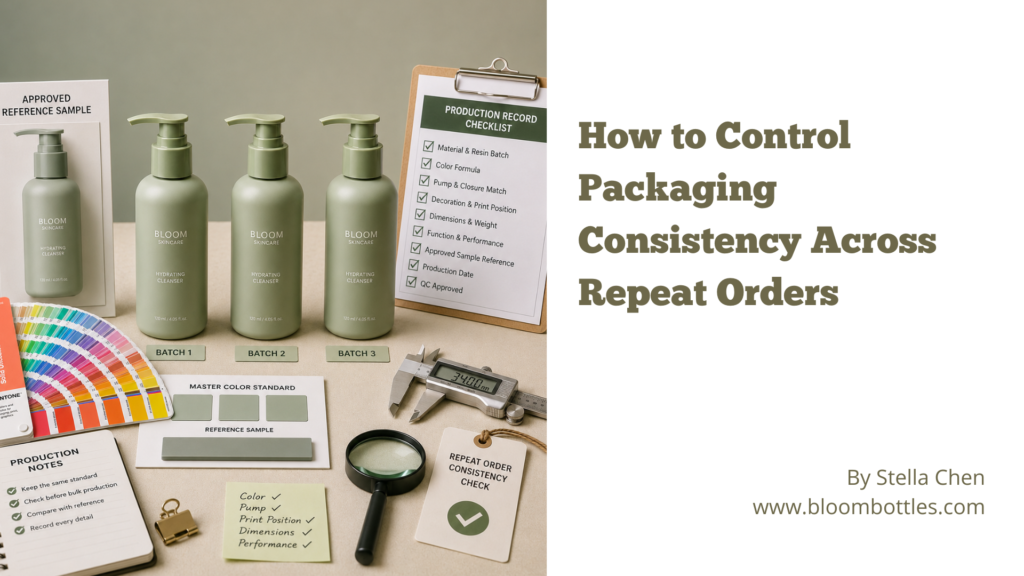
Packaging consistency across repeat orders is one of the most important details for skincare and personal care brands after the first production run. The first order may be approved, shipped and filled successfully. But the next order still needs to match the approved standard.
A small color difference, a slightly different cap shade, a decoration shift or a pump mismatch may not look serious at first. However, when products appear side by side on shelf, in e-commerce photos or across different batches, these differences can affect brand trust.
For scale-stage brands and contract manufacturers, repeat-order consistency is not only a quality issue. It is also a communication, documentation and production control issue.
Why Repeat-Order Packaging Consistency Matters
Many packaging problems do not appear during the first sample review. They appear when the brand places repeat orders, adds new SKUs or changes production timing.
A brand may approve one bottle color in the first order. Months later, the next order may use a different raw material batch, pigment batch, mold condition, decoration setup or closure production lot. Without clear records, the new batch may not match the original approved packaging.
This can create extra approval rounds, filling delays, customer complaints, inventory mismatch or unnecessary rework.
This is why brands should treat repeat orders as controlled production, not simply as “make the same again.” If the first project is still being validated, our article on why approved packaging samples still need testing before production explains why sample approval and production control are different steps.
Where Packaging Inconsistency Usually Comes From
1. Color Standards Are Not Clearly Defined
Color is one of the most common sources of repeat-order differences.
A bottle color may look acceptable during the first approval. But if the brand does not define the approved color standard clearly, the next production batch may create a visible difference.
Color can be affected by resin batch, pigment batch, PCR content, wall thickness, surface finish, mold temperature and production conditions. Even the same color formula can look slightly different on different materials or structures.
For better control, the team should keep a physical color reference sample, not only a Pantone number or digital image. Digital screens cannot show real plastic color accurately enough for production approval.
2. Material Batch Variation Is Not Considered
Plastic packaging can vary when the raw material source or batch changes. This is especially important for PCR plastic packaging, translucent bottles, light colors and natural resin colors.
For example, PCR PET or PCR HDPE may show shade variation from batch to batch. The difference may be acceptable for some brands, but it may not work for packaging that needs a very clean, premium or color-sensitive appearance.
If your team is evaluating PCR for future orders, our guide on PCR plastic packaging explains how PCR percentage, color and production stability should be reviewed before approval.
3. Decoration Setup Changes Between Orders
Decoration consistency is not only about artwork files. It also depends on the actual production setup.
Silk screen printing, hot stamping, labels, spray coating, frosting and gradient finishes can all vary if the project does not control the approved sample, artwork version, fixture, printing position, ink color, foil color or surface treatment.
For repeat orders, the supplier should check the new decoration result against the approved master sample before mass production continues. This is especially important for large logo areas, special finishes, metallic effects and multi-SKU projects.
4. Closure Components Are Changed Without Full Review
A bottle may remain the same, but a small closure change can affect the full packaging system.
If the cap, pump, sprayer, liner, plug or gasket changes between orders, the team should not assume the package still performs the same way. A slightly different closure can affect sealing, dispensing, torque, appearance and carton packing.
This is why bottle and closure records should stay together. Our article on choosing the right bottle and closure system for skincare packaging explains why components should be reviewed as one system instead of separate parts.
5. Reference Samples Are Missing or Outdated
Repeat-order control becomes difficult when the team cannot confirm which sample represents the final approved version.
During packaging development, brands may review several rounds of samples. There may be one sample for bottle color, another for cap color, another for decoration and another for final assembly. If these samples are not clearly labeled, the next order can easily follow the wrong reference.
A master reference sample should show the final approved combination. It should include the bottle or jar, closure, color, decoration, liner, finish and any special production notes.
6. Production Records Are Not Detailed Enough
Good repeat-order consistency depends on good records.
For every approved packaging project, the supplier and brand should keep clear records of material type, color formula, pigment reference, mold number, closure specification, decoration file, production date, approved sample and quality notes.
Without these records, repeat orders rely too much on memory. That creates risk when team members change, suppliers change, production lines change or the next order happens months later.
Quality management systems such as ISO 9001 emphasize consistent processes and documented quality control. For packaging projects, the same thinking helps reduce avoidable variation across repeat orders.
Common Repeat-Order Packaging Problems
Color Looks Slightly Different From the Last Order
This can happen because of raw material batch, pigment batch, production temperature, PCR content, surface finish or bottle wall thickness. It may also happen when the team compares the new batch with a photo instead of a physical reference sample.
Cap and Bottle Colors Do Not Match
Caps and bottles may use different materials and production processes. For example, a PP cap and a PET bottle may not show color in the same way, even if both follow the same Pantone target.
Logo Position Shifts Between Batches
Decoration position can shift when the fixture, bottle orientation, printing setup or artwork reference changes. This is more visible on curved bottles, slim bottles and packaging with tight logo placement.
Pump or Sprayer Performance Feels Different
A pump or sprayer may feel different if the supplier changes the component lot or internal structure. The team should check dosage, dip tube length, locking function and compatibility with the formula before accepting a change.
Repeat Orders Take Longer Than Expected
Repeat orders can still take longer if the team needs to re-confirm color, decoration, cap matching or sample approval. Strong records can reduce repeated discussion and shorten confirmation time.
How to Control Packaging Consistency Across Repeat Orders
Confirm a Master Reference Sample
Before the first order moves into production, confirm the master reference sample. This sample should show the final approved packaging system, not only one component.
The master sample should include the approved bottle or jar, cap, pump, sprayer, liner, color, finish and decoration. Both the brand and supplier should keep reference samples when possible.
Keep Clear Color and Decoration Records
A repeat order needs more than a product name or item code. The supplier should keep the approved color formula, pigment reference, material type, decoration file, printing position and production notes.
When the brand updates artwork, logo size, label material or color direction, the team should record the change clearly. This prevents old and new versions from mixing in future production.
Compare New Production With the Approved Sample
For repeat orders, do not only check whether the new batch looks acceptable by itself. Compare it with the approved master sample.
This comparison should cover color, transparency, surface finish, decoration position, closure fit, pump function, cap tightness and general appearance.
Control Component Changes Carefully
If any component changes, the supplier should notify the brand before production. This includes changes to material, resin source, closure supplier, liner, pump structure, decoration method or carton packing.
Even when the replacement looks similar, the team should check whether it affects filling, sealing, dispensing, shipping or shelf appearance.
Use Pre-Production Checks for Repeat Orders
Repeat orders should still include pre-production checks, especially when the order is large, the color is sensitive, the decoration is complex or the project has not run for several months.
A short pre-production check can help confirm color, closure matching, decoration and packing before mass production continues. This is much easier than solving problems after the full batch is finished.
This approach is also connected to how brands evaluate plastic packaging before you scale, especially when packaging moves from first approval to repeat production.
Align Inventory and Production Timing
Repeat-order consistency also depends on timing. If a brand orders caps, bottles, pumps or labels at different times, the components may come from different batches. This can increase the chance of visible variation.
When possible, plan related components together. This helps suppliers control color matching, assembly fit, production schedule and shipping arrangement more smoothly.
A Practical Repeat-Order Consistency Checklist
Before placing or producing a repeat order, brands and suppliers can review these questions:
- Do we have the correct master reference sample?
- Are the bottle, jar, cap, pump or sprayer specifications unchanged?
- Is the material type the same as the approved order?
- Has the PCR percentage or resin source changed?
- Is the approved color formula still available?
- Are the decoration artwork and position unchanged?
- Do we need a pre-production sample before mass production?
- Has the closure supplier or component structure changed?
- Do carton packing and shipping conditions remain the same?
- Are all changes recorded before production starts?
Final Thought
Packaging consistency across repeat orders does not happen by accident. It depends on clear samples, accurate records, stable materials, controlled decoration and careful component matching.
For skincare and personal care brands, the first approved order should become the foundation for future production. The supplier should not only make the same item again. They should understand what needs to stay the same and what needs rechecking before production.
When brands and suppliers manage repeat orders with this mindset, they can reduce color differences, decoration shifts, closure mismatches, approval delays and long-term packaging instability.
FAQ
1. Why does packaging look different across repeat orders?
Packaging may look different because of raw material batches, pigment batches, PCR content, production conditions, decoration setup, closure changes or missing reference samples.
2. How can brands control packaging color consistency?
Brands can control color consistency by keeping physical reference samples, confirming color formulas, reviewing real production samples and comparing repeat orders against the approved master sample.
3. Should repeat orders still need pre-production checks?
Yes, especially when the order uses custom colors, PCR material, special decoration, pumps, sprayers or components that have not been produced for several months. A short pre-production check can prevent larger problems later.
4. What records should suppliers keep for repeat packaging orders?
Suppliers should keep records of material type, color formula, pigment reference, mold number, closure specification, decoration file, production date, approved sample, quality notes and any approved changes.