
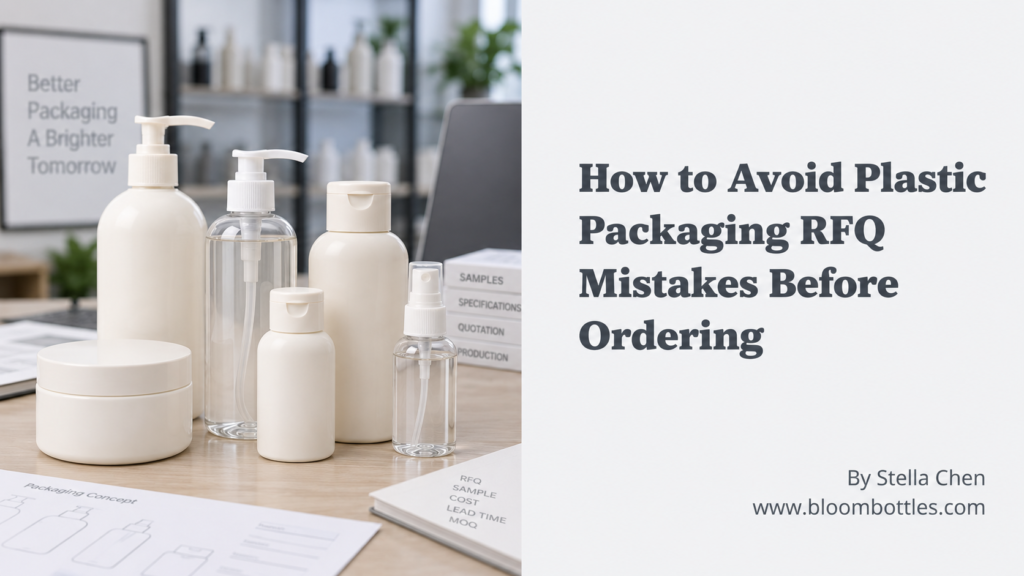
Many plastic packaging RFQs start with a short request: “Please quote a 250 ml bottle with pump.” The supplier can respond, but the first quotation may not be very useful if the quantity, material, decoration, closure requirements and project timing are still unclear.
A useful plastic packaging RFQ does not need every technical detail to be final. It does need enough project context for the supplier to understand what should be quoted, which existing options may fit and where further development may be required.
When the right information is shared early, brands and contract manufacturers can get clearer pricing, more realistic lead times and more relevant sample options with fewer rounds of back-and-forth.
Why a Plastic Packaging RFQ Affects More Than Unit Price
Plastic packaging quotations depend on more than bottle capacity.
Material, bottle weight, neck finish, pump or closure, color, decoration, order quantity, mold requirements and packing method can all change the quotation.
The same 250 ml bottle can represent very different projects. One brand may need a clear PET bottle with a standard flip-top cap. Another may need PCR PET, a custom color, silk screen printing and a lotion pump. A third may need a completely new bottle shape.
If the supplier does not know which project it is quoting, a low initial unit price may not represent the final packaging system.
This is also why brands should compare plastic packaging quotations beyond unit price once quotations are received.
Mistake 1: Sending Only a Bottle Photo and Capacity
Reference photos are useful. They help a supplier understand the general shape, proportion and packaging style a brand wants.
But a photo alone usually does not show the material, neck finish, bottle weight, pump output or exact dimensions.
When sending a reference image, explain which features actually matter. For example, the brand may want a similar shoulder shape but does not need the same cap. Or the bottle diameter may matter because it must fit an existing carton or filling line.
This helps the supplier understand whether an existing package could work or whether the project may need custom development.
If the design is still open, reviewing stock vs custom plastic packaging can help the team decide how much customization is really needed.
Mistake 2: Requesting a Quote Without a Target Quantity
Order quantity is one of the most useful pieces of information in a plastic packaging RFQ.
Bottle production, closures, pumps, decoration and color customization may have different MOQ requirements. Unit cost can also change when the project moves from a small trial quantity to a full production order.
The quantity does not need to be a final purchase order quantity. A realistic target range is often enough for the first review.
For example:
- Initial order: 10,000 to 20,000 pieces
- Expected repeat order: quarterly
- Estimated annual demand: 80,000 to 100,000 pieces
This information lets the supplier evaluate more realistic production options. Brands that are still deciding order size can also review how to plan plastic packaging MOQ before finalizing the RFQ.
Mistake 3: Quoting the Bottle but Forgetting the Closure System
A bottle quotation is not always a complete packaging quotation.
If the product requires a lotion pump, fine-mist sprayer, flip-top cap, disc-top cap, screw cap or induction liner, include that information in the RFQ.
When the exact closure is not final, describe the intended function instead.
- Lotion pump for a body lotion
- Fine-mist sprayer for a hair product
- Flip-top cap for shampoo
- Wide-mouth screw cap for a powder product
- Pump with overcap for transport protection
This gives the supplier enough direction to recommend a compatible system instead of pricing the bottle as an isolated component.
Mistake 4: Leaving Material and Appearance Too Open
The brand does not always need to specify the exact plastic grade during the first inquiry. But basic material and appearance preferences help narrow the options.
Useful information may include:
- Clear or transparent appearance
- Natural or opaque bottle
- PET, HDPE, PP or PETG preference
- PCR content requirement
- Glossy, matte or frosted appearance
- Custom bottle color
If the brand is not sure which material fits the project, that can remain an open question for supplier review. It is better to explain the required appearance and product application than to select a material only because another brand uses it.
Mistake 5: Asking for Decoration Pricing Without Explaining the Design
Decoration can change both cost and production planning.
If the project may use silk screen printing, hot stamping, labeling, coating or another finish, mention it during the quotation stage.
Final artwork is not always necessary for an initial quotation. A basic description may be enough to start:
- One-color silk screen printing
- Two-color logo and product information
- Pressure-sensitive label
- Matte coating with printed logo
- Hot stamping on the closure
The supplier can refine decoration pricing after the artwork and printable area are confirmed.
Mistake 6: Asking for Lead Time Without Sharing the Project Stage
“What is your lead time?” can have several different answers.
An existing bottle in a standard color follows a different timeline from a custom-color bottle with decoration. A new mold adds another development stage before production can begin.
Tell the supplier where the project currently stands.
- Early concept review
- Packaging sourcing
- Samples needed for formula testing
- Artwork under development
- Launch date already confirmed
- Existing package needs a replacement supplier
A target filling date or required arrival date is even more useful than simply asking for production lead time. It allows the supplier to work backward through sampling, approvals, production and shipping.
If timing is tight, review the main causes of plastic packaging production delays before ordering rather than relying only on the quoted production days.
Mistake 7: Forgetting the Shipping Destination and Trade Requirement
A packaging supplier can quote an EXW or FOB product price without knowing the final destination. But destination information becomes important when the buyer wants freight estimates, carton planning or a landed-cost comparison.
For the initial RFQ, useful information can include the destination country, destination city or port, and the preferred quotation basis when known.
If the packaging will first go to a contract manufacturer rather than the brand’s warehouse, give the filling location instead. This is especially important when the CM is in a different country or region from the brand.
A Plastic Packaging RFQ Is Not the Same as a Final Specification Sheet
One reason brands delay contacting suppliers is that they think every technical detail must already be confirmed.
That is not necessary for an early sourcing discussion.
An RFQ helps the supplier understand the project and prepare an initial recommendation or quotation. A production specification comes later, after the team confirms the bottle, closure, material, decoration and approved samples.
Before mass production, those details should move into a controlled plastic packaging specification sheet.
What Does Not Need to Be Final Before You Contact a Supplier?
A useful first inquiry does not require a complete packaging file.
Depending on the project, these items can still be open:
- Exact bottle dimensions
- Final bottle weight
- Final pump model
- Final dip tube length
- Decoration artwork
- Exact custom color
- Final carton quantity
- Final production specification
The important point is to identify what is already confirmed and what still needs supplier input.
This lets the supplier separate firm requirements from areas where it can recommend alternatives.
A Practical Plastic Packaging RFQ Checklist
For an initial supplier review, try to include the following information:
- Product type or application
- Packaging type: bottle, jar or another format
- Target capacity
- Preferred material or appearance
- Required pump, sprayer or closure type
- Target order quantity
- Estimated annual demand when available
- Bottle or closure color
- Decoration requirement
- Reference photo, drawing or existing sample
- Sample quantity required
- Current project stage
- Target production or launch timing
- Shipping destination
- Any special filling or compatibility requirement
You do not need an answer for every item before sending the RFQ. Mark uncertain items as open and ask the supplier to recommend suitable options.
A Simple RFQ Example
A useful first inquiry can be simple:
- Product: body lotion
- Target size: 250 ml
- Package: plastic bottle with lotion pump
- Material: HDPE preferred, open to alternatives
- Color: custom light beige
- Decoration: one-color silk screen printing
- Initial quantity: 20,000 pieces
- Annual forecast: approximately 80,000 pieces
- Samples: 5 complete sets for formula and filling review
- Target filling date: December
- Destination: contract manufacturer in the United States
This is not a final production specification. But it gives a packaging supplier enough information to start checking suitable bottles, pumps, MOQ, decoration feasibility, sample availability and project timing.
What Should You Review After the Supplier Responds?
A supplier response should help move the project forward, not only return a unit price.
Review whether the response clearly addresses:
- Recommended bottle and closure combination
- Material and PCR options when requested
- MOQ
- Unit price and what it includes
- Decoration cost
- Sample availability and lead time
- Custom mold cost when required
- Production lead time
- Packing method
- Quotation validity
- Shipping term
The quality of this response is also useful when you evaluate a plastic packaging supplier. A supplier that identifies missing information and explains practical options can often provide more value than one that simply returns the lowest number.
Final Thought
A good plastic packaging RFQ does not need to answer every technical question before the first supplier conversation.
It should give enough information to understand the product, packaging direction, quantity, timing and open decisions. The supplier can then help narrow the remaining options through drawings, samples and technical review.
For brands and contract manufacturers, this approach makes the first quotation more useful and reduces unnecessary back-and-forth. It also makes it easier to identify whether a packaging supplier understands the project before the team invests more time in sampling or custom development.
If you are preparing a skincare or personal care packaging project, start with the information you already have: target capacity, packaging type, closure, quantity, decoration direction, timing and destination. The remaining details can be reviewed step by step with the packaging supplier.
FAQ
What information should be included in a plastic packaging RFQ?
Include the product application, packaging type, capacity, preferred material, closure, quantity, decoration, timing and destination. Reference images or samples are also useful when available.
Do I need final packaging artwork before requesting a quote?
Not always. For an initial quotation, describe the expected decoration method and number of colors when possible. The supplier can update the decoration cost after final artwork review.
Can I request a packaging quote if I have not chosen PET, HDPE or PP yet?
Yes. Explain the product application, required appearance and other project needs. The supplier can review suitable material options before the final specification is confirmed.
Why does a packaging supplier need my target order quantity?
Quantity affects production methods, MOQ, decoration options and unit pricing. A realistic target range helps the supplier recommend packaging that fits the expected scale of the project.