
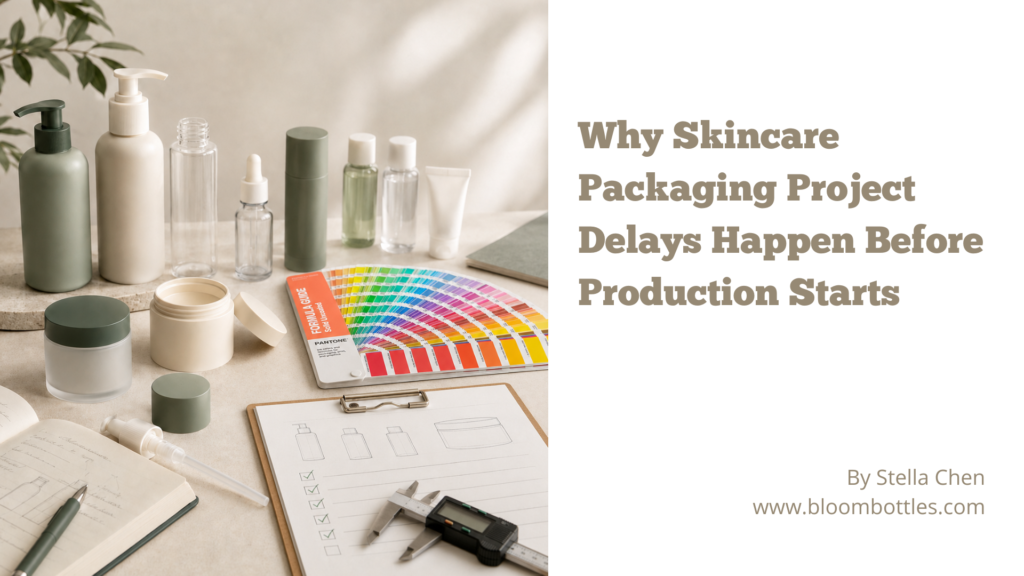
Skincare packaging project delays often happen before production even starts. The bottle may look acceptable, the cap may seem confirmed, and the decoration may appear simple. But once formula, filling, testing, artwork, tooling and approval details come together, small unresolved decisions can slow down the whole project.
For skincare brands and contract manufacturers, this delay rarely comes from one big problem. More often, many small details were not reviewed early enough.
Before placing a production order, brands need more than a good-looking sample. They need to know whether the packaging can move smoothly from sample approval to real production, filling, shipping and repeat orders.

Why Packaging Delays Before Production Matter
Pre-production delays can affect much more than the packaging schedule.
When packaging is delayed, formula filling may move back. Product launch dates may change. Contract manufacturers may need to adjust production lines. Marketing teams may have to wait for final artwork or product photos. Purchasing teams may need to recheck costs, shipping windows or inventory plans.
This is why packaging decisions should not become a late-stage purchasing step. For scale-stage skincare and personal care projects, packaging is not a small detail. It is part of the product development system.
If the project team only reviews appearance, price and MOQ, important production details may stay hidden until it is too late to fix them easily. This is one reason why brands should evaluate plastic packaging before you scale, not only after problems appear.
Common Reasons Skincare Packaging Projects Get Delayed
1. The Packaging Brief Is Not Clear Enough
Many delays begin with an incomplete packaging brief.
A supplier may receive a request such as “we need a 250ml lotion bottle with a pump” or “we want a PET toner bottle with a premium finish.” This may sound clear at first. In practice, it is not enough for production planning.
A practical packaging brief should include:
- Product category and formula type
- Filling volume and overflow capacity requirements
- Closure type, such as pump, sprayer, disc top cap or flip top cap
- Neck finish requirement
- Decoration method
- Target order quantity
- Filling process and filling temperature
- Shipping destination and carton requirements
- Timeline for samples, testing, approval and production
Without these details, the supplier may first quote or sample based on assumptions. Later, when the brand adds more requirements, the project may need another review.
This does not mean the brand did anything wrong. It simply means packaging development needs practical information from the beginning.
2. Formula Compatibility Is Checked Too Late
Formula compatibility is one of the most common causes of skincare packaging project delays.
A bottle may look suitable from the outside. However, skincare formulas can behave differently depending on ingredients, viscosity, alcohol content, essential oils, fragrance, acidity or surfactant level.
For example, a toner, body oil, lotion, scrub, cleanser and sunscreen may all need different packaging considerations. Some formulas need stronger chemical resistance. Some need better dispensing control. Others may need specific liners, pumps or more careful leakage testing.
If the team selects packaging before confirming formula requirements, the project may need to go backward later.
This is why choosing the right plastic packaging should not only consider bottle shape or material name. It should also consider how the formula will interact with the packaging during storage, filling, use and transportation.
3. Bottle and Closure Matching Is Not Confirmed Early
Many projects focus on the bottle first and leave the closure decision until later. This can create delays.
In real production, the bottle and closure must work as one system. A pump, sprayer, cap, liner or plug may affect leakage control, dispensing performance, filling line operation and consumer use.
Even when the neck size looks correct, the project team still needs to check other details:
- Thread matching
- Gasket or liner fit
- Dip tube length
- Pump dosage
- Torque requirement
- Sealing surface
- Closure height and appearance
- Carton packing stability
If the team changes the closure late, the project may need new samples, new testing or even new carton packing checks.
For this reason, brands should review the bottle, cap, pump, sprayer and liner together. Our article on choosing the right bottle and closure system for skincare packaging explains why component matching should be part of the early discussion.
4. Decoration Is Treated as a Final Visual Step
Teams often discuss decoration after selecting the bottle shape. But decoration can affect project timing.
Silk screen printing, hot stamping, labels, spray coating, frosting, gradient finish and shrink sleeves all have different production requirements. Some need a stable front surface. Some need enough flat area. Some may require extra protection during shipping or filling. Others need color matching and artwork adjustment before mass production.
If the team confirms decoration too late, the project may face delays in:
- Artwork preparation
- Printing plate or tooling setup
- Color approval
- Sample correction
- Production scheduling
- Packing method adjustment
A decoration effect may look simple on a rendering. Real production needs suitable bottle geometry, material surface and process control.
For scale-stage projects, decoration should be discussed before the bottle is fully confirmed, not after everything else is finished.
5. Samples Are Approved Without Enough Testing Time
Approving a sample is important, but it does not prove production readiness.
A sample can confirm appearance, size, basic assembly and general direction. Mass production adds more variables, including batch variation, filling line pressure, transport conditions, storage conditions and repeated use.
If the purchasing team starts testing only when the order becomes urgent, the project can quickly lose time.
Typical tests may include:
- Formula compatibility test
- Leakage test
- Drop test
- Transport simulation
- Pump or sprayer function test
- Decoration adhesion test
- Filling line trial
For transport-related validation, some teams also refer to recognized packaging test procedures such as ISTA packaging test procedures when planning shipment simulation.
This is why approved packaging samples still need testing before production. Testing should be built into the development timeline, not added only when the order is already urgent.
6. Custom Mold Decisions Are Made Too Late
When a stock bottle cannot meet the project needs, a custom mold may be a better long-term solution. But custom packaging needs more planning time.
New mold development may involve 2D drawing, 3D design, mold quotation, prototype review, mold opening, trial samples, correction and final approval. If the brand starts with a stock bottle direction and later decides to change to a custom bottle, the timeline will naturally extend.
This does not mean custom packaging is slow or unsuitable. It means the team should make the decision at the right stage.
For brands with repeat orders, strong shelf identity or special functional needs, custom packaging may reduce long-term limitations. The project team should decide early whether the goal is stock packaging, semi-custom packaging or full custom packaging. If this decision is still open, our guide on stock vs custom plastic packaging may help clarify the direction.
7. Too Many Teams Approve Different Details Separately
Packaging delays also happen when different teams focus on different priorities.
For example:
- Marketing wants a premium appearance
- R&D wants formula compatibility
- Purchasing wants cost control
- Operations wants filling efficiency
- Quality wants testing stability
- Sales wants the launch date protected
All of these concerns are reasonable. However, when teams review them separately and too late, the packaging supplier may receive conflicting feedback.
Marketing may approve a bottle that filling later rejects. A pump may look good but fail to match the formula viscosity. A decoration may support the brand image but create production risk. A lower-cost option may save money at first but increase testing rounds.
Clear approval responsibility helps reduce repeated changes before production.
Common Problems Brands See Before Production Starts
When packaging details are not aligned early, brands may see problems such as:
- The selected pump does not match the formula viscosity
- The cap color needs multiple correction rounds
- The bottle shape does not suit the planned label
- The decoration area is too curved or unstable
- The supplier needs more information before confirming the quote
- The approved sample still needs compatibility testing
- The carton packing method needs to change after closure confirmation
- The launch schedule becomes difficult because testing was not planned early
Some of these problems seem small. But when several appear together, they can delay the whole project.
Production itself does not always cause packaging delays. Unresolved decisions before production often create the real delay.
How to Reduce Skincare Packaging Project Delays
Start With a Complete Packaging Brief
A clear brief helps the supplier understand the project faster and provide more practical suggestions.
A packaging brief does not need to be perfect. It should still include the main product, formula, volume, closure, decoration, quantity, timeline and testing expectations.
When some details are not confirmed yet, say so clearly. A good supplier can help identify what the team should decide first.
Discuss Formula, Filling and Shipping Together
Teams should not review packaging only by appearance.
Before production, the project team should consider:
- Will the formula affect the bottle material?
- Will the closure seal properly after filling?
- Will the pump or sprayer dispense correctly?
- Will the packaging survive shipping conditions?
- Will the decoration stay stable during handling?
For liquid products, leakage risk should be reviewed early. Our article on why plastic packaging leaks during shipping explains how sealing, closure fit, liners, filling and transport conditions can all affect leakage performance.
Confirm the Component System Before Final Approval
Before moving into production, confirm the full packaging system:
- Bottle or jar
- Cap, pump or sprayer
- Liner, plug or sealing method
- Decoration process
- Carton packing
- Testing requirement
- Reference sample
This review helps avoid late changes after one component has already received approval.
Build Testing Time Into the Project Timeline
Teams should not treat testing as an emergency step.
If the brand needs formula compatibility testing, leakage testing, filling line testing or decoration testing, the team should add these checks to the timeline before the production order becomes urgent.
This matters most for new formulas, new closures, new decoration effects, PCR materials, custom molds and first-time suppliers.
Involve the Supplier Before Everything Is Locked
A packaging supplier can often identify risks before they become delays.
For example, the supplier may notice that a planned decoration needs a flatter surface. A pump may need testing with the actual formula. A custom color may need more approval time. A stock bottle may not support the desired brand direction.
Supplier input is most useful before the design is fully locked. Once artwork, timeline, launch plan and budget are already fixed, every correction becomes harder.
Final Thought
Skincare packaging project delays are not always production problems. Many delays begin before production starts, when packaging details are not fully aligned.
For skincare and personal care brands, the goal is not only to approve a sample. The goal is to make sure the packaging can move smoothly through testing, production, filling, shipping and repeat orders.
Reviewing material, formula compatibility, closure matching, decoration, testing and supplier input earlier can help reduce late changes, unnecessary testing rounds and project delays.
For scale-stage brands and contract manufacturers, this early review is often what keeps a packaging project stable before it reaches production.
FAQ
1. Why do skincare packaging projects get delayed before production?
Skincare packaging projects often get delayed because teams confirm important details too late. These may include formula compatibility, closure matching, decoration method, testing requirements, artwork approval, custom mold decisions or filling line requirements.
2. Is sample approval enough before placing a production order?
No. Sample approval is useful, but it does not replace testing. A sample can confirm appearance and basic fit. Real production may involve formula interaction, filling pressure, transport vibration, batch variation and repeated use.
3. When should a packaging supplier be involved in the project?
A packaging supplier should join the discussion before the design, closure, decoration and timeline are fully locked. Early supplier input can help identify practical production risks and reduce later changes.
4. How can brands reduce skincare packaging project delays?
Brands can reduce delays by preparing a clear packaging brief, confirming the full component system, testing with the actual formula, reviewing decoration feasibility early and allowing enough time for sample correction and validation.