
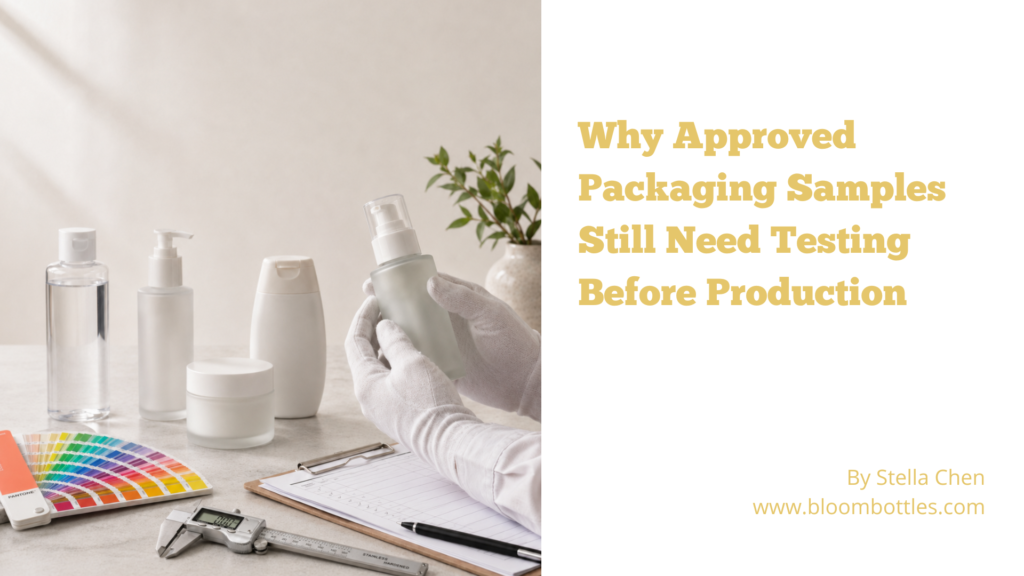
Approved packaging samples before production are important, but they should not be treated as the final proof that everything will run smoothly. For skincare and personal care brands, an approved sample usually confirms the direction, appearance and basic function. It does not always confirm full production performance.
A bottle may look correct. A pump may dispense during sample review. A cap may close properly by hand. But real production adds more variables, including filling speed, capping force, formula behavior, batch variation, carton packing, shipping pressure and repeated consumer use.
For scale-stage skincare brands and contract manufacturers, the question is not only whether the sample has been approved. The better question is whether the packaging has been checked under conditions close to real production and real use.
If your team is still reviewing the full packaging structure, you may also find our guide on choosing the right bottle and closure system for skincare packaging useful before final production approval.
What an Approved Packaging Sample Usually Confirms
An approved packaging sample is valuable because it gives the brand, supplier and contract manufacturer a physical reference. It helps confirm whether the packaging direction is acceptable before production starts.
In most projects, approved samples are used to check appearance, color direction, decoration position, bottle shape, closure style, basic assembly and general product presentation.
This is necessary. Without a confirmed sample, production teams may not have a clear reference for what should be made. But the sample should be understood correctly. It is a reference point, not a complete risk assessment.
What an Approved Sample Does Not Always Confirm
A sample is usually reviewed under controlled conditions. It may be checked by hand, in small quantity and without the full pressure of real filling, packing and shipping. This means some risks may remain hidden until production or shipment.
Formula Compatibility
A sample can show whether the bottle and closure look suitable, but it does not always prove long-term formula compatibility. Some formulas contain fragrance, oil, alcohol, surfactants or active ingredients that may affect the bottle, pump, liner or decoration over time.
This is why packaging material and formula should be reviewed together before larger orders. If material selection is still uncertain, our guide on PET vs HDPE vs PP skincare packaging can help compare common plastic options.
Filling and Capping Performance
Hand-assembled samples do not always represent real filling line conditions. During production, packaging may need to handle filling speed, conveyor movement, torque control, pump assembly, cap tightening and operator handling.
A component that works well in a small sample set may still slow down production if it is difficult to fill, cap, align or pack consistently.
Sealing and Shipping Stability
An approved sample may close properly during review, but sealing performance should still be checked under more realistic conditions. Leakage can be affected by cap fit, pump structure, liner selection, thread engagement, filling level, carton packing and transport pressure.
This is especially important for international shipments. You can read more in our guide on why plastic packaging leaks during shipping.
Decoration Durability
Decoration may look good on the approved sample, but production handling and shipping can create different conditions. Silk screen printing, hot stamping, labels, spray coating and frosted finishes may all need to be checked for adhesion, rubbing, alignment and protection during packing.
This is especially important when the packaging uses special finishes, large decoration areas, tight logo positioning or multiple SKU colors.
Why Packaging Problems Can Appear After Approval
Many packaging problems appear after sample approval because approval and validation are not the same thing. Approval confirms that the sample is acceptable. Validation checks whether the packaging can perform under real conditions.
Sample Review Often Focuses on Appearance
During sample approval, teams often focus on visible details such as shape, color, transparency, logo position, finish and overall shelf look. These details matter, but they do not cover the full packaging system.
Small Differences Become Larger at Scale
A small color difference, slight pump direction issue or minor decoration shift may seem acceptable in one sample. But in larger production, these differences can affect carton inspection, filling confidence, customer approval and repeat-order consistency.
Real Production Removes Many Manual Workarounds
Samples can often be adjusted by hand. Production cannot rely on the same level of manual correction. Once volume increases, packaging needs to be predictable enough for repeated filling, capping, packing and shipping.
This is why brands should treat sample approval as one step in the decision process, not the last step before production.
Common Issues That Approved Samples May Not Reveal
Color Variation Between Sample and Production
Color can vary because of material batch, PCR content, surface finish, wall thickness, pigment adjustment or production conditions. A color sample is useful, but teams should also confirm how much variation is acceptable before production.
Logo or Decoration Position Shift
Decoration position may shift slightly during production, especially on curved bottles, soft bottles or packaging with limited stable printing areas. If exact alignment is important, the acceptable range should be discussed before mass production.
Pump or Cap Direction Inconsistency
For pump bottles and flip top caps, direction and position can affect shelf appearance and filling line handling. If the brand has specific direction requirements, this should be confirmed before production rather than discovered during filling.
Weak Performance After Repeated Use
Some caps and pumps perform well during first inspection but change after repeated opening, closing, pressing or locking. Repeated-use checks can help identify issues before packaging reaches consumers.
Leakage After Filling or Shipping
Leakage risk may not appear in an empty sample. It often becomes visible only after filling, capping, carton packing, temperature change, pressure change or long-distance transportation.
How to Use Approved Samples Before Production
Approved samples are most useful when they are used as a communication tool before production. They should help all sides align on what matters most, what variation is acceptable and what should be checked again before filling or shipment.
1. Confirm the Master Reference Sample
Before production starts, the team should confirm which sample is the final reference. This helps avoid confusion when there are multiple rounds of samples, color adjustments or decoration trials.
The master reference sample should be clearly connected to the approved color, finish, decoration, closure and component combination.
2. Identify the Most Important Control Points
Not every small difference carries the same risk. Before production, the brand, supplier and contract manufacturer should align on the points that matter most.
These may include color consistency, logo position, pump output, cap tightness, sealing performance, bottle shape, fill level, carton packing or decoration durability.
3. Test the Full Packaging System
Do not test the bottle, cap, pump or label only as separate parts. The full packaging system should be reviewed together with the formula, closure, decoration, liner and expected filling process.
This is closely related to how brands evaluate plastic packaging before they scale.
4. Review Filling and Capping Conditions
If the packaging will be filled by a contract manufacturer, production conditions should be discussed before final approval becomes locked. Filling speed, capping method, torque, pump assembly and carton packing may all affect performance.
5. Define What Requires Recheck or Hold
One practical way to reduce delays is to define decision points before production. Some small differences may be acceptable. Some issues may need recheck. Some problems should pause production until the team confirms the next step.
This helps avoid production teams waiting for unclear approval when a small but important difference appears during filling or packing.
A Simple Decision Guide Before Production
Before production starts, teams can use a simple decision guide to align expectations.
Continue
Continue when the difference is minor, already expected and does not affect function, brand appearance, sealing, filling or consumer use.
Recheck
Recheck when the difference may affect appearance, function or production consistency, but the risk is not yet clear enough to stop the project.
Hold
Hold when the issue may affect leakage, dispensing, closure fit, decoration quality, filling performance or customer approval.
Escalate
Escalate when the issue may affect shipment, launch timing, product safety, claim risk or long-term repeat-order stability.
When Extra Testing Is Especially Important
Not every project needs the same testing level. But some packaging projects should be reviewed more carefully before production.
Custom Colors or Special Finishes
Custom colors, frosted surfaces, spray coating, hot stamping and large decoration areas may need additional checks for consistency and durability.
Pump or Sprayer Packaging
Pumps and sprayers should be checked with the formula because viscosity, dip tube length, output and locking structure can affect user experience and production performance.
Products Filled by Contract Manufacturers
When a contract manufacturer handles filling, the packaging should be reviewed with the expected filling and capping process. This reduces the chance of surprises during production.
Large Repeat Orders
For larger or repeat orders, small inconsistencies can create bigger operational cost. Approved samples should help guide repeat-order consistency, not only first-order approval.
Final Thought
Approved packaging samples before production are important, but approval should not be confused with full validation.
A sample can confirm the packaging direction. Production needs clearer judgment about formula compatibility, filling performance, closure fit, decoration stability, shipping risk and acceptable variation.
For skincare and personal care brands, using approved samples as a production communication tool can help reduce repeated confirmation, filling delays, shipment problems and long-term packaging instability.
FAQ
Does an approved packaging sample mean the packaging is ready for production?
Not always. An approved sample confirms that the sample is acceptable, but production readiness also depends on formula compatibility, filling conditions, closure performance, decoration stability and shipping risk.
What should brands check after approving packaging samples?
Brands should check the full packaging system, including bottle, cap, pump, liner, formula, decoration, filling process, sealing performance and packing method.
Why do packaging issues appear after sample approval?
Issues may appear later because samples are often reviewed in small quantities and controlled conditions. Real production adds more variables, including batch variation, filling speed, capping force, transport pressure and repeated use.
Should contract manufacturers be involved before final packaging approval?
Yes, when possible. Contract manufacturers can help check filling, capping, handling and packing conditions before production, which can reduce delays and unclear decisions later.