
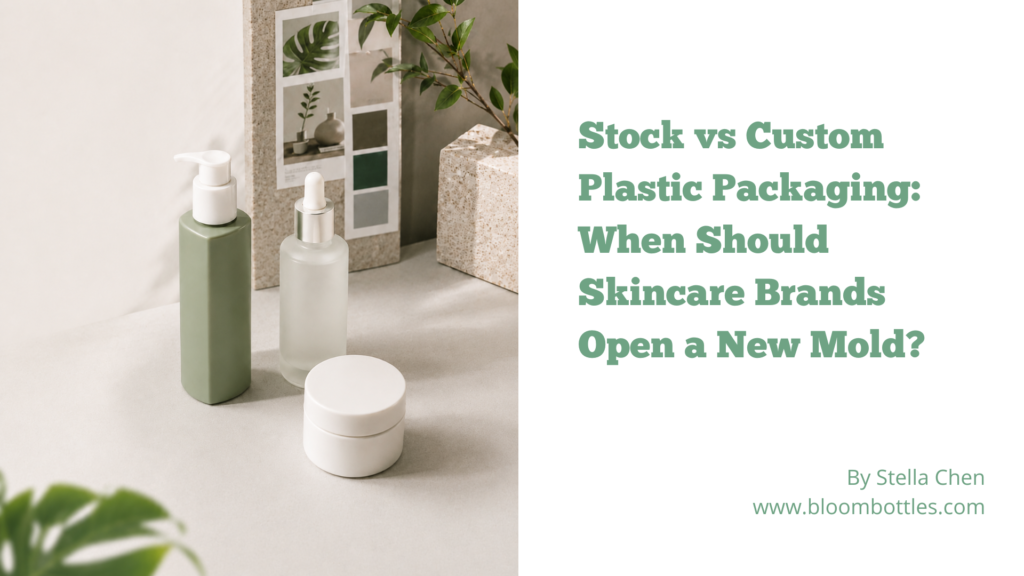
Choosing between stock and custom plastic packaging is an important decision for skincare and personal care brands. Stock packaging can be faster and more practical, while custom packaging can support stronger brand differentiation when the timing, volume and structure are right.
The challenge is that many brands start thinking about custom packaging too early, or too late. If the decision is made too early, the project may carry unnecessary mold cost and complexity. If the decision is made too late, the brand may struggle with packaging limitations, unstable component matching or weak shelf differentiation.
For scale-stage skincare brands and contract manufacturers, the right question is not only whether custom plastic packaging is possible. The better question is whether opening a new mold makes sense for the product, order plan, supply chain and long-term brand direction.
If you are still reviewing the basic packaging structure, you may also find our guide on choosing the right bottle and closure system for skincare packaging helpful before deciding whether a new mold is needed.
What Is Stock Plastic Packaging?
Stock plastic packaging refers to existing bottle, jar, cap, pump or closure designs that are already available from a supplier. The mold already exists, so brands do not need to invest in a completely new mold before production.
Stock packaging is commonly used for skincare, hair care, body care and personal care products, especially when the brand needs a practical solution with shorter development time.
For many projects, stock packaging is not a lower-quality choice. It can be the right choice when speed, cost control, proven structure and production stability matter more than a fully unique shape.
What Is Custom Plastic Packaging?
Custom plastic packaging usually means developing a new bottle, jar, cap or closure design based on the brand’s specific requirements. This may involve opening a new mold, adjusting structure, designing a new shape or developing a more specific packaging system.
Custom packaging can help a brand build stronger shelf recognition, improve product function, solve existing packaging limitations or create a more consistent brand experience across product lines.
However, custom packaging is not only a design upgrade. It is also a supply chain and production decision. A new mold affects cost, lead time, testing, approval, repeat orders and long-term packaging control.
Stock vs Custom Plastic Packaging: The Main Difference
The main difference between stock and custom plastic packaging is not simply whether the packaging looks unique. The real difference is how much control, cost, development time and long-term commitment the project requires.
Stock Packaging Reduces Development Complexity
Stock packaging is usually easier to evaluate because the structure already exists. Brands can review samples, test compatibility and confirm decoration options without starting from a new mold.
This can reduce early project risk, especially when the brand is still testing a product line, validating market demand or comparing different packaging directions.
Custom Packaging Gives More Control
Custom packaging gives the brand more control over shape, capacity, structure, closure matching, decoration area and product presentation. This can be valuable when standard packaging no longer supports the brand’s needs.
But more control also means more responsibility. The new packaging needs to be designed, tooled, sampled, tested, approved and repeated consistently across future orders.
When Stock Plastic Packaging Is the Better Choice
1. The Product Is Still in an Early Growth Stage
If the brand is still testing the market, stock packaging is often more practical. It allows the team to launch faster, control development cost and avoid locking into a structure before the product direction is stable.
2. The Existing Structure Already Works Well
If an existing bottle, jar or closure already matches the formula, filling process, decoration method and shipping requirements, opening a new mold may not add enough value.
In many cases, changing color, finish, decoration or closure style can already create enough differentiation without creating a completely new structure.
3. Speed Is More Important Than Full Differentiation
Stock packaging can be a better choice when the project timeline is tight. New mold development requires design confirmation, mold making, sampling, adjustment and testing. If the launch date is fixed, stock packaging may reduce schedule pressure.
4. The Brand Does Not Yet Have Stable Forecasts
Custom packaging becomes more practical when the brand has stable demand and repeat-order visibility. If forecasts are uncertain, stock packaging can help reduce the risk of over-investing in a structure that may not be used long term.
When Custom Plastic Packaging Starts to Make Sense
1. Stock Packaging Limits Brand Differentiation
Custom packaging may make sense when stock options no longer support the brand’s market position. This is common when many competing products use similar bottles or jars, and the brand needs a stronger visual identity on shelf or online.
In this case, the new mold should not only create a different look. It should support a clearer brand direction, better product experience and stronger long-term recognition.
2. The Current Packaging Creates Repeated Problems
A new mold may be worth considering when the current packaging creates repeated issues that cannot be solved through simple component changes. These problems may include poor closure matching, unstable dispensing, difficult filling, weak structure or repeated leakage risk.
If the issue is related to the full packaging system, the brand should first evaluate whether the problem can be solved through better component matching. You can also read our guide on why plastic packaging leaks during shipping to understand how sealing and structure affect transport performance.
3. The Order Volume Can Support Mold Investment
Custom packaging usually requires a mold investment. This investment becomes more reasonable when the product has stable demand, repeat orders and enough volume to spread the mold cost over time.
For scale-stage brands, the focus should not only be the mold fee. The team should also consider testing cost, approval time, production planning, storage, supply continuity and future order stability.
4. The Brand Needs Better System Control
Custom packaging can give the brand better control over bottle shape, closure fit, decoration area, wall thickness, grip feel and product family consistency. This can be valuable when packaging becomes part of the brand’s long-term operating system.
Before making this decision, brands should evaluate whether the full packaging system is ready for scale. This connects closely with how to evaluate plastic packaging before you scale.
Semi-Custom Packaging: A Practical Middle Option
Between stock and fully custom packaging, semi-custom packaging can be a practical option for many skincare brands. This may include using an existing mold while customizing color, finish, decoration, closure combination or PCR material options.
Semi-custom packaging can help brands improve shelf appeal without taking on the full cost and development risk of a completely new mold.
For example, a brand may use an existing PET bottle but customize the color, silk-screen printing, hot stamping, label, pump color or cap finish. This can create a more branded appearance while keeping the basic structure proven.
This option is often useful when the brand needs differentiation but does not yet need a fully unique bottle or jar shape.
Questions to Ask Before Opening a New Mold
Before opening a new mold for skincare packaging, brands and contract manufacturers should review the decision from both design and production perspectives.
Is the Current Packaging Limitation Clear?
A new mold should solve a clear problem or create clear value. If the reason is only that the team wants something different, semi-custom packaging may be a better first step.
Can the Volume Support the Mold Cost?
The mold fee should be reviewed together with expected order volume and repeat-order plans. A mold may look expensive at first, but it can become reasonable when the same packaging is used across stable future orders.
Has the Full Packaging System Been Checked?
A custom bottle still needs the right closure, pump, liner, decoration and filling process. The new mold should be developed with the full system in mind, not only the bottle shape.
Is the Timeline Realistic?
Custom packaging takes time. Brands should allow time for design, mold making, sampling, adjustment, compatibility checks and production preparation. If the timeline is too tight, stock or semi-custom packaging may be safer.
Will the Packaging Be Used Long Term?
Custom packaging works best when it supports a long-term product line or brand system. If the product is temporary, seasonal or uncertain, a new mold may add unnecessary complexity.
Common Mistakes When Choosing Custom Packaging
Choosing Custom Packaging Only for Appearance
Appearance matters, but it should not be the only reason to open a new mold. The packaging also needs to support filling, sealing, handling, shipping and repeat production.
Ignoring Closure and Pump Compatibility
A custom bottle shape does not guarantee a stable packaging system. The closure, pump, sprayer or jar lid must be evaluated together with the bottle or jar. Otherwise, the project may look good but perform poorly.
Underestimating Development Time
Custom packaging is not only mold making. It includes design review, tooling, sampling, testing, approval and possible adjustment. If the schedule does not allow enough time, the project may face pressure before production starts.
Not Planning for Repeat Orders
A custom mold should support more than one launch. Brands should consider future volumes, color plans, decoration consistency, storage needs and supply continuity before confirming the investment.
Final Thought
There is no single right answer between stock and custom plastic packaging. Stock packaging can be the smarter choice when speed, proven structure and cost control matter. Custom packaging can be the better choice when differentiation, system control and long-term volume justify the investment.
For skincare and personal care brands, opening a new mold should not be treated as a design upgrade only. It should be treated as a scale decision that affects cost, timing, production stability and future repeat orders.
Before choosing stock, semi-custom or custom packaging, it is worth reviewing the formula, closure system, filling process, decoration needs, order plan and long-term brand direction together.
FAQ
Is stock packaging suitable for skincare brands?
Yes. Stock packaging can be suitable for many skincare brands, especially when the existing bottle, jar or closure already matches the formula, filling process, decoration needs and shipping requirements.
When should a skincare brand open a new mold?
A skincare brand should consider opening a new mold when stock packaging limits brand differentiation, creates repeated performance problems or no longer supports the product’s scale and long-term order plan.
Is custom plastic packaging always better than stock packaging?
No. Custom packaging is not always better. It gives more control, but it also adds mold cost, development time, testing needs and production complexity. The decision should depend on product stage, volume and long-term value.
What is semi-custom plastic packaging?
Semi-custom plastic packaging uses an existing mold but customizes details such as color, finish, decoration, closure combination or PCR material option. It can offer a balance between differentiation and development efficiency.