
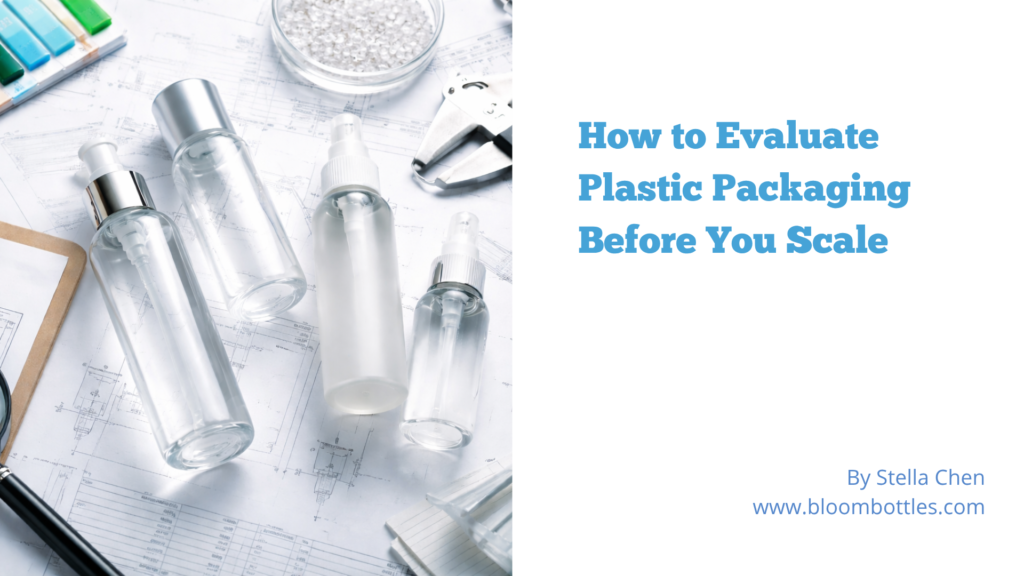
Choosing a bottle that looks right is not enough. To evaluate plastic packaging before you scale, you need to look beyond the sample and ask whether the full system will still work when volumes grow.For skincare and personal care brands, many packaging problems do not begin when a project fails. They begin much earlier, when packaging is approved based on appearance, basic compatibility, or unit price, but has not been evaluated under real filling, shipping, and repeat order conditions.A packaging solution may look fine in a sample round and still create problems later. That is why scale-stage packaging decisions need a different way of thinking.
Why packaging evaluation changes when volume grows
At an early stage, many packaging decisions are made around speed. The bottle looks good, the cap fits, the pump works in a quick test, and the cost seems acceptable. That may be enough for a small launch.But once volume increases, packaging is no longer just a component choice. It becomes part of an operating system.The question is no longer, “Can this package work?” The real question becomes, “Can this package keep working consistently across production, filling, shipping, and repeat orders?”That is where many teams get surprised.
Sample approval does not prove repeatability
A sample can confirm that a package is directionally right. It does not prove that it will perform the same way across larger production runs.In small quantities, problems are easier to hide. Teams may hand-check more parts. Filling conditions may be simpler. Shipping pressure may be lower. Small adjustments can compensate for a package that is not truly stable.At scale, those small gaps become much harder to manage.
This is also why many early packaging decisions create hidden risks later. You can also read our article on common plastic packaging mistakes.
A component may work alone but fail as a system
A bottle may be acceptable on its own. A pump may also be acceptable on its own. The decoration may look good on a sample. But packaging performance depends on how these parts work together.For example, a bottle and pump can match by neck finish, but still create dosage inconsistency if the formula viscosity is not considered. A cap may close properly, but still increase leakage risk if liner choice, torque control, and transport conditions are not aligned.This is why packaging should not be evaluated as separate parts only. It should be evaluated as a working system.
Small inefficiencies become expensive later
A packaging issue does not need to cause a complete failure to become costly.A slightly unstable pump output, a decoration process with lower consistency, or a bottle shape that reduces filling efficiency may seem manageable at first. But when order volume increases, these small inefficiencies start affecting labor, output, timelines, and freight performance.That is why packaging evaluation before scaling should focus on predictability, not only on first-sample approval.
A practical framework to evaluate plastic packaging before you scale
Before scaling a packaging project, it helps to review six areas. This approach is especially useful for skincare and personal care brands working with PET, HDPE, PP, or PCR packaging.
1. Check formula compatibility, not just bottle appearance
The first question is not whether the bottle looks right. It is whether the package works with the product inside.Different formulas behave differently. A toner, lotion, cream, gel, or body wash may each create different requirements for material choice, closure fit, pump output, and sealing performance.When evaluating packaging, ask:Will this material work with the formula over time?Will the pump or cap function consistently with this viscosity?Will the package still perform after storage and transport?A good-looking bottle is not enough if the product experience becomes unstable later.
2. Check component fit and tolerance
Packaging problems often come from component matching, not from one single part being “bad.”Bottle, pump, cap, liner, and seal all need to work together within controlled tolerances. Even when thread size looks correct on paper, small differences can affect sealing, leakage risk, or user experience.Before scaling, confirm:Whether the closure system has been matched and tested as a full setWhether sealing performance has been checked under realistic conditionsWhether there is enough tolerance control for repeat productionThis step is especially important when different components come from different suppliers.
3. Check filling line reality
A packaging design that works in a sample room may not work well on an actual filling line.This is where many scale-stage problems start. Bottle stability, opening size, pump assembly, decoration durability, and shape complexity can all affect production efficiency.Before confirming packaging, review:How the bottle runs during fillingWhether the package shape causes handling issuesWhether the closure application is stableWhether decoration holds up during line processingPackaging should support efficient production, not create extra friction for the filling team.
4. Check shipping and leakage risk early
Shipping performance should not be treated as a final-stage check only.Leakage, cap loosening, scuffing, and breakage risks often start with earlier packaging decisions. A closure system that appears acceptable in internal tests may behave very differently under long-d
Shipping performance should not be treated as a final-stage check only.Leakage, cap loosening, scuffing, and breakage risks often start with earlier packaging decisions. A closure system that appears acceptable in internal tests may behave very differently under long-distance transport, pallet pressure, temperature change, or repeated handling.Before scaling, ask:Has the package been tested for shipping risk?Has leakage prevention been reviewed as part of the closure system?Has outer packing been considered together with the primary packaging?A package that survives approval but struggles in transit is not scale-ready.
5. Check decoration consistency across repeat orders
Decoration is often evaluated based on visual effect. But for scaling brands, consistency matters just as much as appearance.Screen printing, hot stamping, spray coating, matte finishes, and color matching may all look good in a pre-production sample. The real question is whether that same result can be repeated across batches without slowing production or increasing rejection rates.Before scaling, review:Whether the decoration method is stable for the selected materialWhether the finish can be repeated consistently across future ordersWhether decoration complexity is aligned with production efficiencyA decorative upgrade should add value without reducing repeatability.
6. Check supply continuity and change control
At scale, packaging is also a supply chain decision.A packaging solution may perform well technically, but still create problems if lead times are unstable, replacement parts are difficult to control, or future changes are hard to manage.Before scaling, consider:Whether the supply structure is simple enough to support repeat ordersWhether the package depends on too many separate vendorsWhether future color, decoration, or component changes can be managed without major disruptionThe more complex the package becomes, the more important change control becomes.
What brands should ask before locking packaging
Before final approval, skincare and personal care brands should ask a few direct questions.Has this package been evaluated as a full system, not just as separate components?Has it been checked under real production and shipping conditions?Can the same performance be repeated across future orders?Will this packaging still be manageable when SKU volume grows?If the answer is unclear, the project may still be in a sample-ready stage, not a scale-ready stage.
When stock packaging is enough and when deeper evaluation is needed
Not every packaging project needs a highly customized structure. In many cases, stock or semi-custom packaging is the right choice.But even stock packaging should be evaluated properly before scaling. A standard bottle is not automatically a low-risk bottle. Once formula, pump, decoration, filling conditions, and shipping route are added, the real complexity can change.Deeper evaluation becomes more important when:The formula is sensitiveThe closure system is more demandingThe decoration is more complexThe shipping route is longerThe order volume is increasingThe goal is not to make packaging more complicated. The goal is to make packaging more predictable.
Final thoughts
To evaluate plastic packaging before you scale, brands need to move beyond sample approval and start looking at system performance.The best packaging choice is not always the one that looks best in the first round or costs the least per piece. It is the one that can stay stable across production, filling, shipping, and repeat orders.That is where supplier-side evaluation becomes valuable. It helps teams identify problems earlier, reduce hidden cost, and make packaging decisions that support growth instead of slowing it down.If a packaging project is moving toward larger volume, this is the right stage to review the bottle, closure, formula, decoration, and logistics as one system, not as separate decisions.
If you are still at the selection stage, you can also read our guide on choosing the right plastic packaging.
FAQ
1. What does it mean to evaluate plastic packaging before scaling?
It means checking whether the packaging can perform consistently when order volume increases. This includes material compatibility, component fit, filling line performance, shipping risk, decoration stability, and supply continuity.
2. Why is sample approval not enough?
A sample only shows that the package works in a limited situation. It does not prove that the same result can be repeated across production runs, shipping conditions, and future orders.
3. What packaging issues usually appear after scaling?
Common problems include leakage during shipping, pump performance inconsistency, decoration variation, filling inefficiency, and component mismatch between suppliers.
4. Do stock packaging solutions still need full evaluation?
Yes. Stock packaging can still create problems if formula, closure, decoration, or shipping conditions are not properly reviewed. Standard packaging does not always mean low risk.
Reviewing a packaging project before scale? BLOOM BOTTLES supports skincare and personal care brands with custom PET, HDPE, PP, and PCR packaging development built for repeatable production and long-term supply.