
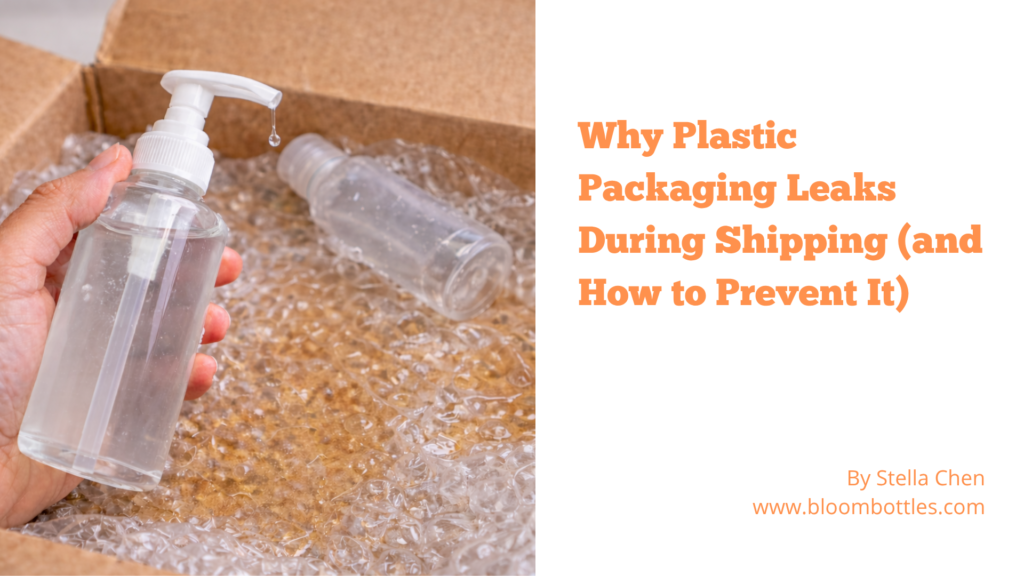
Leakage is one of the most common and costly packaging issues in skincare and personal care products.
Products that perform well in testing often fail during transportation. This can lead to damaged goods, customer complaints, and increased operational costs.
Understanding why plastic packaging leaks during shipping is essential for brands that want to scale reliably.
Plastic packaging leakage during shipping is often caused by compatibility issues, sealing problems, and transport conditions.
Why Packaging That Works in Testing Fails in Shipping
Many packaging systems are tested under controlled conditions. However, shipping introduces additional stress that is not present during initial testing.
Common factors include pressure changes, vibration over long distances, temperature variation, and stacking weight.
These conditions expose weaknesses that are not visible during early development.
Common Causes of Packaging Leakage
1. Poor closures Compatibility
Leakage often occurs when bottles and closures are not perfectly matched.
This is one of the most common packaging mistakes brands make when scaling production.
Typical issues include mismatched threads, loose fit between cap and neck, and pump systems that are not suitable for the product viscosity.
Even small differences in tolerance can lead to leakage during transport.
2. Missing or Inadequate Sealing
Without proper sealing, liquid products can leak easily.
Examples include the absence of inner liners, lack of induction seals, and weak sealing structures.
This becomes more critical for long-distance shipping.
3. Incorrect Material Selection
Material behavior directly affects performance during transportation.
Rigid materials may crack under pressure. Flexible materials may deform and loosen closures.
Choosing the wrong material increases leakage risk.
4. Pump and Dispensing Issues
Dispensing systems can create internal pressure inside the bottle.
Common problems include pumps releasing product during vibration, lack of locking mechanisms, and overly sensitive dispensing heads.
5. Insufficient Transport Testing
Many brands do not simulate real shipping conditions during development.
As a result, vibration impact is underestimated and packaging failure only appears after shipment.
How to Prevent Packaging Leakage
1. Test Packaging as a Complete System
Always test the bottle, closure, and pump together.
Testing components separately does not reflect real-world performance.
2. Add Sealing Solutions
Depending on the product, consider adding induction seals, inner liners, or tamper-evident closures.
3. Match Material to Application
Material selection should consider product viscosity, shipping conditions, and usage behavior.
4. Simulate Real Shipping Conditions
Testing should include vibration testing, drop testing, and pressure testing.
This helps identify potential failure points before production.
5. Avoid Last-Minute Packaging Changes
Late changes often lead to compatibility issues, insufficient testing, and production delays.
Final Thoughts
Packaging leakage is rarely caused by a single issue. It is usually the result of multiple small decisions made during development.
For growing skincare brands, preventing leakage is not just about packaging quality. It requires a system-level approach that considers material, structure, and real-world conditions.
You can also read our guide on choosing plastic packaging to better understand how to build a stable packaging system from the beginning.
FAQ: Packaging Leakage
Why do bottles leak during shipping but not during testing?
Because shipping introduces vibration, pressure, and temperature changes that are not present during standard testing conditions.
How can I prevent lotion bottles from leaking?
Ensure compatibility between bottle, closure, and pump. Adding sealing solutions such as liners or induction seals can significantly reduce leakage.
Are pumps more likely to leak than caps?
Yes. Pumps can create internal pressure and are more sensitive to vibration, especially when there is no locking mechanism.