
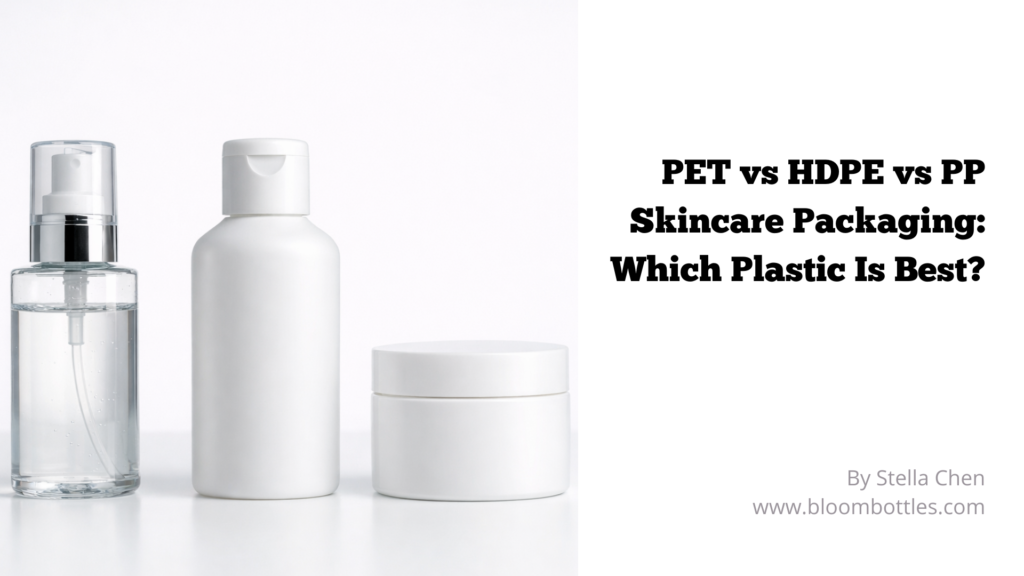
Choosing between PET, HDPE and PP skincare packaging is not only a material decision. For skincare and personal care brands, the right material affects product compatibility, shelf appearance, filling performance, closure matching, shipping stability and repeat-order consistency.
PET, HDPE and PP each have different strengths. The best choice depends on your formula, product format, filling process, decoration needs and long-term packaging plan.
Understanding these differences helps brands and contract manufacturers avoid material mismatch, reduce packaging risks and build more stable packaging systems before moving into larger orders.
If you are still at the early selection stage, you may also find this guide on choosing the right plastic packaging helpful.
What Is PET, HDPE, and PP in Cosmetic Packaging?
- PET (Polyethylene Terephthalate)
Known for its high clarity and premium appearance, commonly used for toners, serums, and transparent packaging. - HDPE (High-Density Polyethylene)
Durable and flexible, widely used for shampoos, lotions, and squeeze bottles. - PP (Polypropylene)
Heat-resistant and chemically stable, often used for jars, caps, and airless systems.
To better understand their differences, let’s compare PET, HDPE, and PP across key performance factors.
PET vs HDPE vs PP: Key Differences
1. Appearance and Brand Positioning
- PET offers a glass-like, transparePET offers a glass-like, transparent look and is often suitable for premium or clean beauty brands.
- HDPE provides a more functional, matte finish
- PP is typically opaque and used more for structural components
This makes PET a strong option when visual presentation is important.
2. Compatibility with Formulations
- PET works well with low-viscosity, water-based formulas
- HDPE handles thicker, oil-based, or surfactant-heavy products better
- PP offers strong chemical resistance and stability
Choosing the wrong material can lead to deformation, stress cracking, leakage or other common packaging mistakes that become more costly after production starts.
3. Squeezability and User Experience
- PET is rigid and not ideal for squeezing
- HDPE is flexible and suitable for daily-use products like shampoo or lotion
- PP varies depending on structure but is less commonly used for squeeze bottles
HDPE is typically preferred when controlled dispensing is required
4. Cost and Scalability
- PET molds and production are generally cost-efficient at scale
- HDPE offers stable production and consistent supply
- PP can be slightly higher in cost depending on application
Cost differences become more significant at container-level volumes
5. Sustainability and PCR Options
- PET is widely used in PCR (recycled) packaging
- HDPE also supports PCR, though with more variation in color
- PP recycling infrastructure is less developed in some markets
There is no single “best” material — only the most suitable one for your product and scale.
How to Choose Between PET, HDPE and PP for Skincare Packaging
Choose PET when clarity and shelf appearance matter
PET is often a good choice when the brand wants a clear bottle, glossy shelf presentation and strong product visibility. It is commonly used for toners, lotions, body wash, shampoo and conditioner packaging.
Choose HDPE when squeezability and durability matter
HDPE is often suitable for products that need a squeezable bottle and stronger daily-use performance, such as shampoo, conditioner, body wash, cleanser and lotion packaging.
Choose PP when closure, jar or structural performance matters
PP is widely used for jars, caps, closures, inner plugs and other functional packaging components. It is especially important when packaging structure, sealing performance or closure matching affects product use.
Final Thought
Material selection is not just a technical decision — it directly affects product performance, brand perception, and long-term cost structure.
Many packaging issues at scale come from selecting materials based only on appearance or short-term cost.
FAQ: PET vs HDPE vs PP
Is PET better than HDPE for skincare packaging?
Not necessarily. PET is better for visual appeal and transparency, while HDPE performs better for squeezable and thicker formulations.
Can PP be used for bottles?
PP is less commonly used for standard bottles but is widely used for caps, jars, and specialized systems.
Which plastic is best for sustainable packaging?
PCR PET is currently one of the most widely used and scalable sustainable options, though HDPE PCR is also growing.