
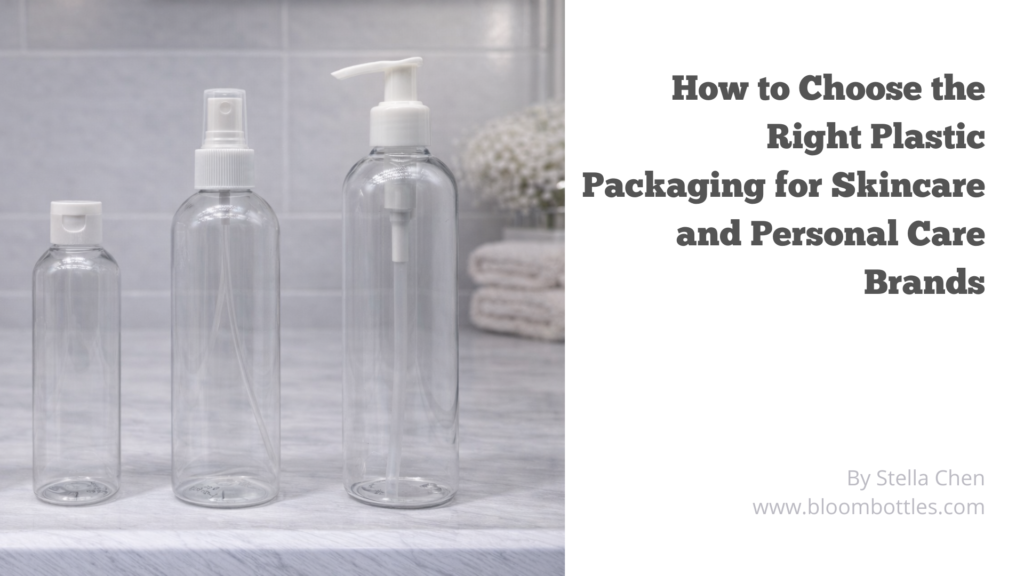
A Practical Guide for Brands Scaling Beyond MOQ Decisions
Choosing the right plastic packaging is one of the most underestimated decisions for skincare and personal care brands. It affects product stability, filling efficiency, logistics cost, sustainability goals, and long-term scalability—not just shelf appearance.Yet many brands still select packaging based on unit price, MOQ, or what worked for the last launch, only to encounter leakage issues, rising costs, or supply bottlenecks once volumes grow.This guide is written for skincare and personal care brands that are scaling, especially those managing container-level orders and long-term supply planning.
This guide focuses on plastic packaging for skincare and personal care brands, addressing common questions such as which plastic bottles work best for lotions, toners, and high-viscosity formulas.
Who This Guide Is For
This article is most relevant if you are:
- A skincare or personal care brand (shampoo, lotion, body care, toner, hair care)
- A contract manufacturer (CM) supporting multiple brands
- Operating at or moving toward container-level orders
- Looking beyond MOQ-based sourcing decisions
- Considering PCR or sustainable packaging options
Step 1: Understand the Most Common Plastic Packaging Materials
Not all plastic bottles for skincare and personal care products such as PET bottles and PE bottles behave the same—especially at scale.
PET (Polyethylene Terephthalate)
Best for:
- Toners, serums, liquid cleansers, transparent packaging
Key advantages:
- High clarity and shelf appeal
- Stable structure for automated filling
- Compatible with PCR content
Considerations:
- Less suitable for very thick or high-viscosity formulas
- May require liner or induction seal for leak prevention
HDPE (High-Density Polyethylene)
Best for:
- Shampoo, body wash, lotion, family-size formats
Key advantages:
- Excellent chemical resistance
- Strong squeeze recovery
- Cost-stable at large volumes
Considerations:
- Opaque appearance
- Decoration choices affect perceived “premium” level
PP (Polypropylene)
Best for:
Key advantages:
- Heat resistance
- Structural rigidity
- Ideal for complex functional parts
Considerations:
- Lower transparency
- Often used as a component rather than a full bottle body
PCR Plastic (Post-Consumer Recycled)
Best for:
- Brands with sustainability commitments or ESG goals
Key advantages:
- Reduced carbon footprint
- Increasing acceptance in North America and EU markets
Considerations:
- Color variation between batches
- Requires early material planning and testing
Key takeaway: There is no “best” material—only the right material for your product, volume, and growth stage.
Step 2: Match Packaging to Product Behavior — Not Just Appearance
Many brands ask questions like “What plastic packaging is best for lotions?” or “How do I prevent leakage in plastic cosmetic packaging during shipping?”
One of the most common mistakes brands make is selecting packaging based on visual references alone.
When selecting plastic bottles for skincare and personal care products, ask these questions early:
- Is the formula thin, medium, or high viscosity?
- Will the product be used in wet environments (bathroom, shower)?
- Is the product filled hot or cold?
- Does it require controlled dosage (pump output)?
For example:
- A thick body lotion paired with the wrong pump output can lead to user frustration and product waste.
- A lightweight toner bottle without proper sealing may leak during long-distance shipping.
Step 3: Think Beyond MOQ — Plan for Scale from Day One
Packaging that works for 5,000 units may fail at 200,000 units.When brands scale, new challenges appear:
- Filling line compatibility
- Consistent color matching across batches
- Stable supply during peak seasons
- Freight cost optimization
This is why container-level planning matters more than MOQ when working with custom plastic packaging solutions for growing brands. At scale, decisions shift from:
- “Is this the cheapest option now?” to
- “Is this stable, repeatable, and predictable over time?”
Step 4: Design for Manufacturing, Not Just Marketing
A packaging design that looks good on screen may introduce hidden risks in production.Key manufacturing considerations include:
- Wall thickness consistency
- Thread and closure compatibility
- Decoration tolerance (screen printing, hot stamping, gradient spray)
- Assembly efficiency at filling facilities
Early 2D/3D validation and functional prototyping help prevent costly revisions later.
Step 5: Sustainability Requires Early Packaging Decisions
Sustainable packaging is not a last-minute switch.If your brand plans to adopt PCR PET, HDPE, or PP:
- Material sourcing must be secured early
- Color expectations should be managed
- Mechanical properties must be tested with the actual formula
Brands that integrate sustainability at the packaging development stage reduce both cost and compliance risk later.
Common Mistake to Avoid
Many brands delay packaging decisions until formulation is finalized. In reality, packaging and formula should evolve together.Late-stage packaging changes often lead to:
- Production delays
- Emergency sourcing
- Compromised packaging performance
Final Thoughts
Brands evaluating plastic packaging for skincare products often compare PET and PE bottles to balance appearance, functionality, and long-term supply stability. Choosing the right plastic packaging is not about trends or shortcuts. It is a strategic decision that affects cost control, brand perception, and operational stability. For growing skincare and personal care brands, the right question is not:“What packaging is cheapest now?”But rather:“What packaging will still work when we scale?”
Ready to Plan Packaging at Scale?
If you’re evaluating PET, PP, HDPE, or PCR packaging for skincare or personal care products—and want to avoid costly missteps as you scale—early planning makes the difference.You can explore more about materials, bottle formats, and customization options on our website, or reach out for a technical discussion based on your product and volume stage.
FAQ: Plastic Packaging for Skincare and Personal Care Brands
What plastic packaging materials are best for skincare products?
There is no single “best” plastic packaging material for all skincare products.
PET is commonly used for toners and transparent bottles, HDPE works well for shampoos and lotions due to its durability, and PP is often used for jars and closures. The right choice depends on formula viscosity, filling conditions, and how the product will be used.
How do I prevent leakage in plastic cosmetic packaging?
Leakage is usually caused by a mismatch between the formula, bottle structure, and closure system.
Selecting the right neck finish, using compatible pumps or caps, and adding liners or induction seals when needed can significantly reduce leakage risks—especially during long-distance shipping.
Should I choose PET or HDPE bottles for lotions and body care products?
For lotions and body care products, HDPE bottles are often preferred because they provide better squeeze recovery and chemical resistance. PET bottles may still be suitable for lighter formulas, but the final choice should consider viscosity, user experience, and filling line compatibility.
Is PCR plastic packaging suitable for skincare and personal care brands?
PCR (Post-Consumer Recycled) plastic packaging is increasingly used in skincare and personal care applications. While PCR materials help reduce environmental impact, brands should plan early for material sourcing, color variation, and testing to ensure consistent quality and performance.